
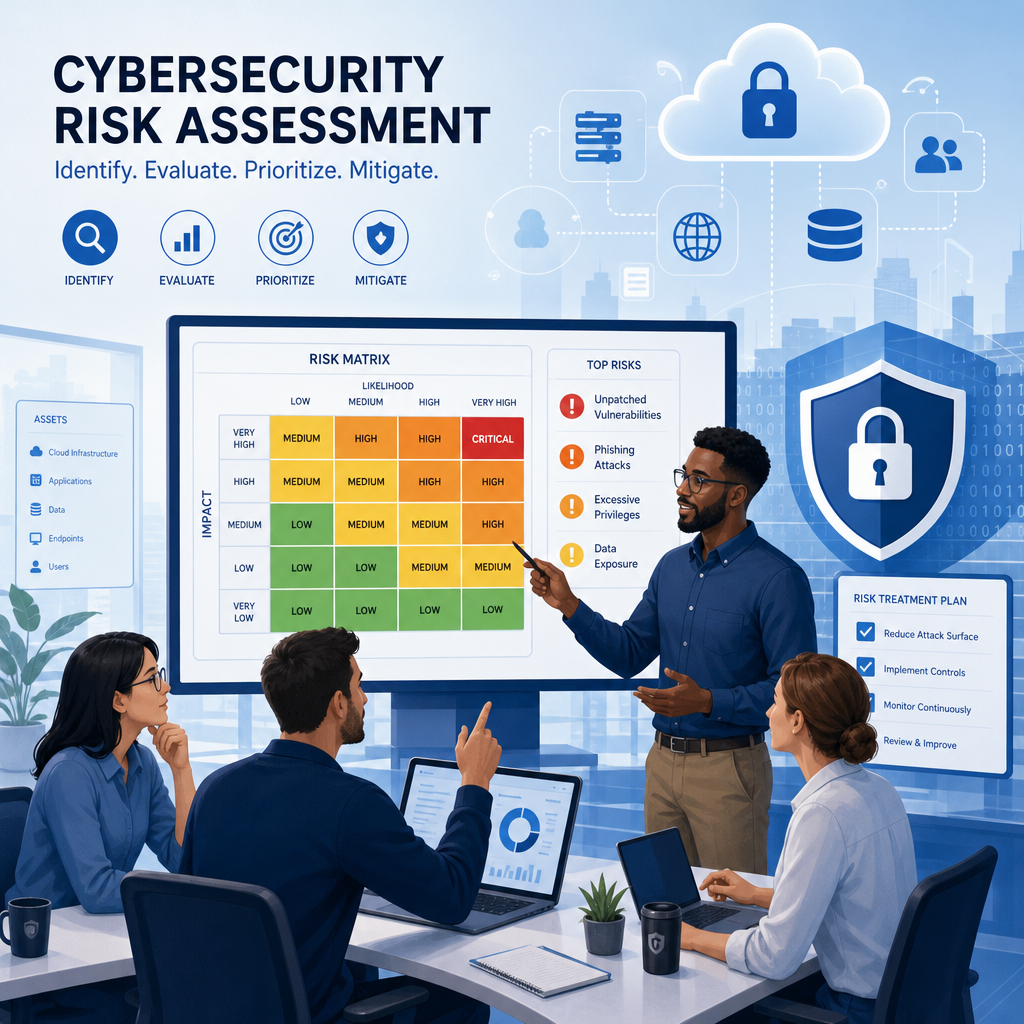
For a startup, risk can feel abstract until it becomes a missed sales opportunity, a disrupted service, or a customer asking difficult security questions. The good news is that risk management does not require a large compliance department or a mountain of paperwork. The ISO 27001 approach gives startups a practical way to identify what matters, understand what could go wrong, and choose sensible protections.
This guide explains risk assessments in plain English. You will learn what an ISO 27001 risk assessment involves, how to complete one with limited resources, and how to turn the results into useful security improvements rather than a box-ticking exercise.
Table of Contents
- Why Risk Assessments Matter for Startups
- The ISO 27001 Risk Assessment Approach
- Define Your Scope and Identify Assets
- Identify Threats and Vulnerabilities
- Analyze and Evaluate Risk
- Choose Risk Treatments and Controls
- Document, Monitor, and Review
- Common Startup Mistakes to Avoid
- A Practical 30-Day Startup Plan
- Conclusion
- Frequently Asked Questions
Why Risk Assessments Matter for Startups
Startups often assume that they are too small to attract attackers. In reality, attackers look for opportunity, not company size. A young business may hold valuable customer information, depend heavily on cloud services, or have informal processes that make mistakes more likely.
A risk assessment helps you focus limited time and money on the issues that could cause the greatest harm. It also gives you a defensible explanation for security decisions. Instead of saying, “We added this tool because it seemed useful,” you can show that a specific risk was identified, evaluated, and addressed.
For growing companies, this discipline supports more than security. It can help with customer due diligence, insurance applications, regulatory expectations, supplier reviews, and future ISO 27001 certification. Most importantly, it creates a repeatable way to make better decisions as the business changes.
The ISO 27001 Risk Assessment Approach
ISO/IEC 27001 is an international standard for an information security management system, commonly called an ISMS. It does not require every organization to use identical technologies or controls. Instead, it expects an organization to understand its risks and select appropriate measures to manage them.
In simple terms, the approach asks five questions:
- What are we trying to protect? Identify information, systems, people, and services that matter.
- What could happen? Consider threats and vulnerabilities that could affect those assets.
- How serious would it be? Estimate the likelihood and impact of each risk.
- What will we do about it? Decide whether to reduce, avoid, transfer, or accept the risk.
- How will we know the decision still makes sense? Monitor changes and review the assessment regularly.
There is no single mandatory scoring formula in ISO 27001. A startup can use a simple low, medium, and high model, provided the criteria are defined and applied consistently.
Define Your Scope and Identify Assets
Begin by defining the part of the business you are assessing. This is known as the scope. A practical startup scope might include the customer-facing application, production cloud environment, employee laptops, core business systems, and the people who operate them.
Do not try to assess everything at once if that would delay useful action. A clearly defined scope is better than a vague assessment of the entire company. You can expand it later as your security program matures.
Build a simple asset inventory
An asset is anything that has value to the organization or supports its information security objectives. Your inventory might include:
- Customer, employee, financial, and intellectual property data.
- Applications, databases, source code, and cloud infrastructure.
- Endpoints, mobile devices, network equipment, and authentication systems.
- Key suppliers, contractors, and managed service providers.
- Business processes such as billing, customer support, deployment, and backups.
- People with privileged access or specialist knowledge.
For each asset, record its owner, location, purpose, and importance. Ownership does not mean that one person must do all the work. It means someone is accountable for helping make decisions about the asset.
Identify Threats and Vulnerabilities
A threat is something that could cause harm. Examples include phishing, ransomware, accidental disclosure, an insider misusing access, a cloud outage, or a supplier suffering a breach. A vulnerability is a weakness that could allow a threat to succeed, such as poor access controls, unpatched software, or an untested recovery process.
For each important asset, ask what could go wrong and why. Discuss these questions with people who understand how the business actually operates. Engineers, customer support staff, finance teams, and founders may see different risks from an IT or security specialist.
Use realistic scenarios
Scenario-based thinking is more useful than a generic list of threats. For example, instead of recording “data breach,” describe a specific situation: an employee receives a convincing phishing email, enters credentials into a fake login page, and an attacker uses the account to access customer records.
Useful prompts include:
- Could unauthorized people access this information?
- Could the information be changed without detection?
- Could the service become unavailable when customers need it?
- Could a supplier, employee, or technical failure disrupt the process?
- Would we know quickly if something went wrong?
- Could we restore operations and meet our legal or contractual obligations?
Analyze and Evaluate Risk
Risk is commonly assessed by considering likelihood and impact. Likelihood asks how probable an event is. Impact asks what the consequences would be if it happened. Consequences may involve confidentiality, integrity, availability, finances, legal obligations, customer trust, or the startup’s ability to operate.
A basic scoring model can use a scale from one to five for each factor. Multiply likelihood by impact to create an overall score, or define categories such as low, medium, and high using a documented table. The mathematics matters less than having a method that is understandable, repeatable, and appropriate for your business.
Set risk criteria
Decide in advance what requires action. For example, a startup may treat any risk involving sensitive personal data, production availability, or a critical customer commitment as high priority, even if the likelihood appears moderate.
It is also useful to define risk acceptance criteria. A low-impact risk might be accepted when the cost of additional protection is disproportionate. However, acceptance should be an intentional decision by an appropriate owner, not an accidental result of inaction. Record who accepted the risk, why, and when the decision will be reviewed.
Choose Risk Treatments and Controls
Once risks are ranked, choose how to treat them. ISO 27001 generally supports four broad options:
- Reduce the risk: Add controls that lower likelihood or impact, such as multi-factor authentication, encryption, backups, or staff training.
- Avoid the risk: Stop a risky activity or redesign a process so the exposure no longer exists.
- Transfer the risk: Share some consequences through contracts, insurance, or a specialist service provider. Responsibility is not always fully transferred, so review agreements carefully.
- Accept the risk: Keep operating with the exposure when it falls within approved tolerance and the decision is documented.
Controls should match the risk. A startup does not need to purchase every security product available. It may gain more value from enforcing strong authentication, removing unnecessary access, patching systems, protecting backups, and establishing a clear incident response process.
Create a treatment plan
Your treatment plan should turn decisions into accountable actions. For every selected improvement, record the risk addressed, the planned control, the owner, the target date, required resources, and the expected result.
For example, if the risk is unauthorized access to a production environment, the plan might include separate administrator accounts, multi-factor authentication, quarterly access reviews, and logging of privileged activity. This is more useful than a general action such as “improve security.”
Document, Monitor, and Review
Good documentation does not need to be complicated. A spreadsheet or lightweight risk register may be enough at the beginning. Typical columns include asset, risk scenario, existing controls, likelihood, impact, risk rating, treatment decision, owner, due date, and review date.
Keep supporting evidence where practical. This might include access review records, backup test results, supplier assessments, security training completion, incident reports, and approval of accepted risks. Evidence helps demonstrate that controls operate in practice rather than existing only in policy documents.
Risk assessment is not a one-time project. Review the register at least annually and whenever there is a significant change, such as a new product, acquisition, major supplier, new regulation, serious incident, or change in infrastructure. Track key risks through management meetings and update priorities when the business changes.
Common Startup Mistakes to Avoid
Several mistakes appear repeatedly in early-stage security programs:
- Making the scope too broad: A massive first assessment can become unmanageable. Start with the systems and information that matter most.
- Confusing threats with risks: “Phishing” is a threat. The risk is the potential business consequence of phishing succeeding against a particular account or process.
- Using scores without context: A numerical rating is only useful when people understand how it was calculated and what action it triggers.
- Listing controls without owners: An unassigned improvement is unlikely to be completed.
- Ignoring suppliers: Cloud platforms, payment providers, contractors, and support tools can influence your security and availability.
- Accepting every risk by default: Silence is not informed acceptance. Decisions should be explicit and approved.
- Trying to solve everything with technology: Clear processes, training, least privilege, and effective communication are often inexpensive and powerful controls.
A Practical 30-Day Startup Plan
A startup can make meaningful progress in a month by keeping the first cycle focused.
- Days 1-5: Define the assessment scope, identify stakeholders, and list important information, systems, services, and suppliers.
- Days 6-12: Hold short workshops with technical and business teams. Record realistic threat scenarios and existing safeguards.
- Days 13-18: Apply your likelihood and impact criteria. Rank the risks and identify the highest-priority exposures.
- Days 19-25: Select treatment options, assign owners, set deadlines, and document any accepted risks with approval.
- Days 26-30: Publish the risk register, begin priority actions, and schedule regular reviews and progress reporting.
This first cycle will not produce perfect knowledge, and it does not need to. Its purpose is to establish a reliable baseline and create momentum. As your team learns more, update the assessment rather than waiting for a complete or flawless document.
Conclusion
An ISO 27001-style risk assessment gives startups a practical language for making security decisions. Identify what matters, consider what could go wrong, evaluate likelihood and impact, and choose controls that are proportionate to the risk.
The strongest approach is consistent rather than complicated. Start with a focused scope, involve people across the business, assign clear ownership, document decisions, and review the results as your startup evolves. Done well, risk assessment reduces surprises, supports growth, and helps customers see that security is being managed responsibly.
Frequently Asked Questions
Does a startup need to be ISO 27001 certified to perform a risk assessment?
No. Any organization can use the ISO 27001 approach to improve information security. Certification is a separate decision that involves demonstrating that the wider information security management system meets the standard’s requirements.
How often should a startup update its risk assessment?
Review it at least annually and whenever significant changes occur. New products, major suppliers, incidents, regulatory changes, or infrastructure changes should trigger an earlier review.
What is the simplest tool for managing a risk register?
A well-structured spreadsheet is often sufficient for an early-stage company. As the number of risks and owners grows, a governance, risk, and compliance platform may provide better workflow, reporting, and audit trails.
Can a startup accept a security risk?
Yes, if the risk is within the organization’s defined tolerance and an appropriate person explicitly approves the decision. Record the reason, owner, date, and review point so acceptance remains deliberate.
Leave a Reply