
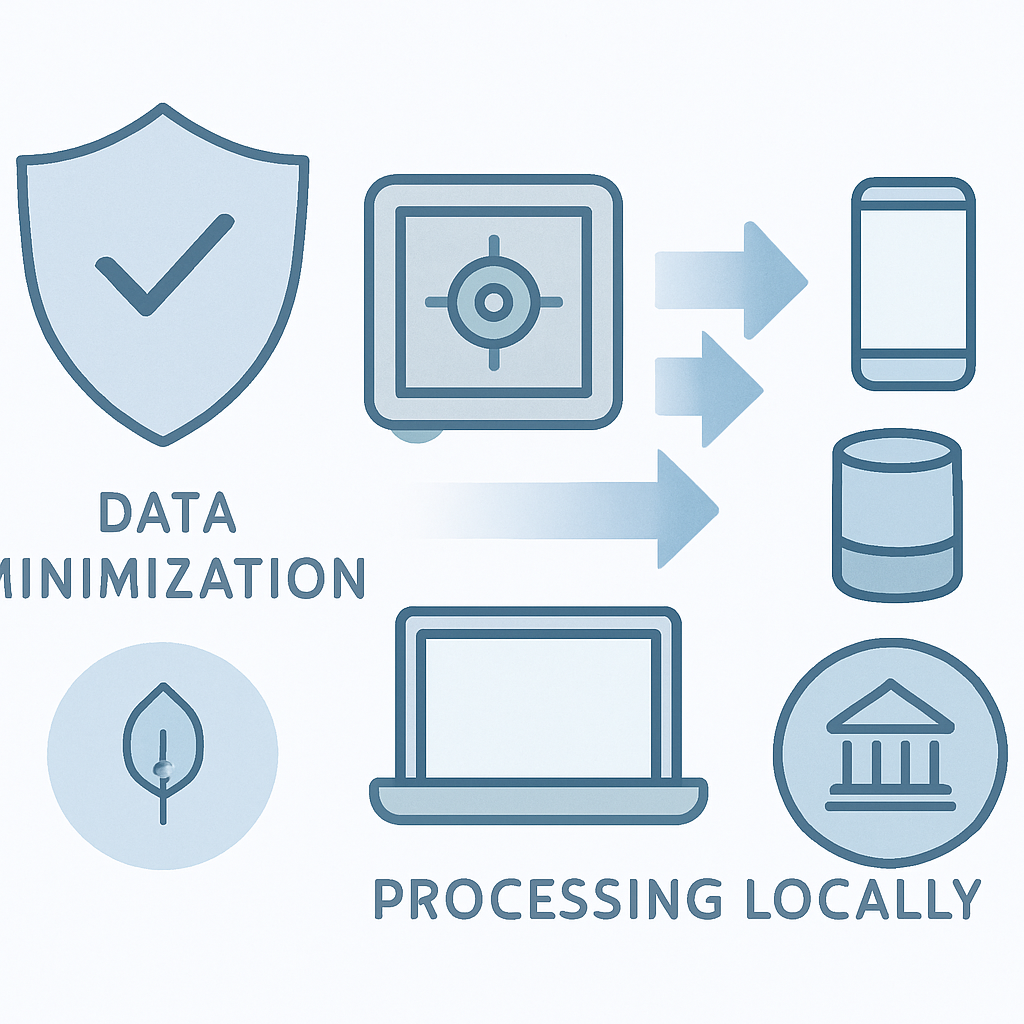
Collect less, risk less. That simple idea sits at the heart of architecting for least data. In a world awash with telemetry, cookies, clickstreams, and AI-ready datasets, the winning move is often to minimize what you collect and how long you keep it—without sacrificing product value. This article explains what “least data” means, how to design for it, and the trade-offs you should expect.
Whether you lead engineering, product, or compliance, you will find practical patterns you can apply today to reduce cost, complexity, and risk while preserving the insights that matter.
Table of Contents
- What Is “Least Data”?
- Why It Matters
- Core Principles
- Architectural Patterns
- Designing Collection and Telemetry
- Storage and Retention
- Privacy-Preserving Techniques
- Governance and Metrics
- Migrating Legacy Systems
- Trade-offs and Decision Frameworks
- Conclusion
- Frequently Asked Questions
What Is “Least Data”?
“Least data” is a design posture: collect the minimum data necessary to deliver a defined value, keep it only as long as it is needed, and store it in the least risky form. It is broader than privacy; it touches cost, security, and operations.
Think of it as the data equivalent of least privilege. Instead of giving every system full access, you scope what is collected, processed, and retained to the smallest set that still achieves the goal.
What it is not
- Not “no data.” You still measure what matters to deliver and improve products.
- Not only a legal checkbox. It is a technical and operational discipline that reduces attack surface and complexity.
- Not anti-analytics. It favors fit-for-purpose analytics over hoarding raw exhaust.
Why It Matters
Data carries gravity. The more you collect, the more systems, people, and processes orbit around it—each adding cost and risk. Minimizing data changes that gravity well.
Business and operational benefits
- Lower cost: Less storage, fewer pipelines, smaller observability bills.
- Less complexity: Simpler schemas and fewer dependencies reduce breakages.
- Faster incident response: Smaller blast radius and fewer sensitive stores.
Trust and regulatory alignment
- User trust: Clear purpose and frictionless controls build confidence.
- Regulations: Data minimization, purpose limitation, and retention rules appear in GDPR, CCPA/CPRA, and many sector standards. See GDPR’s data minimization principle.
Core Principles
Use these principles as guardrails when making design decisions.
- Purpose limitation: Define why you need data before you collect it. No purpose, no data.
- Proportionality: Choose the least sensitive signal that delivers the needed accuracy.
- Default deny: Collection, sharing, and access are opt-in, not the default.
- Ephemeral by default: Prefer streams, windows, caches, and summaries over permanent raw storage.
- Edge-first processing: Compute near the source to filter, aggregate, and anonymize.
- Verifiable controls: Make minimization measurable with policies, contracts, and audits.
Architectural Patterns
1) Bounded contexts and scoped stores
Split monolithic data lakes into domain-aligned stores with explicit contracts. Each service owns only the fields it truly needs, reducing accidental sprawl.
- Design APIs that expose decisions or aggregates instead of raw events.
- Use separate credentials and roles per context to enforce containment.
2) Event-driven with filtration at ingress
Publish events that are scrubbed at the source. Remove unnecessary fields and tokenize sensitive ones before events hit the bus.
- Introduce a sanctioned “ingestion gateway” with schema validation and redaction.
- Reject events that violate data contracts; fail safely rather than ingesting junk.
3) Edge and on-device processing
Compute features, predictions, and aggregates on device or at the edge and send only the result. This reduces identifiers and fine-grained telemetry leaving the client.
- Apply on-device inference and report only confidence and outcome.
- Use coarse sampling and rolling windows to avoid granular tracking.
4) Privacy-preserving analytics by default
Adopt solutions that provide counts, trends, and funnels using aggregation and noise instead of raw user-level data. Many modern analytics tools support these modes.
- Favor cohort analytics and privacy budgets over user-level joins.
- Store only anonymous event summaries unless a feature explicitly needs identity.
5) Tokenization and vaults
When you must handle sensitive fields (payments, PII), store them in a minimal, segregated vault with strict access. Downstream systems use non-sensitive tokens.
- Rotate tokens and keys on a defined cadence.
- Keep the token-to-value mapping short-lived when possible.
Designing Collection and Telemetry
Telemetry is where most organizations over-collect. Architect “decision-ready” signals instead of unbounded exhaust.
Start with questions, not dashboards
- List the decisions you need to make. Map each to the minimal metric or event required.
- Reject any field that does not change a decision or user experience.
Reduce granularity
- Prefer counters, histograms, and percentiles over raw logs.
- Use sampling ratios that adapt to volume; fall back to higher sampling during spikes.
- Bucket timestamps and locations to reduce precision.
Drop identifiers
- Avoid persistent user IDs where not needed. Use session-scoped or ephemeral IDs.
- Strip IP addresses and user agents unless critical; summarize into categories.
Minimize content capture
- Disable verbose logs in production by default. Gate with feature flags and time-boxed overrides.
- Never log secrets or personal content; enforce via linting and pre-commit checks.
Apply privacy budgets
Limit the cumulative sensitivity exposed by repeated queries. Enforce caps per user, per day, or per cohort to avoid reconstruction risks.
Storage and Retention
Storing less—and for less time—is central to least data. Design storage to make deletion the path of least resistance.
Schema for deletion
- Partition by time and by purpose so entire partitions can be dropped on schedule.
- Use separate tables for identifiers and event payloads to enable selective purge.
Retention by configuration
- Attach time-to-live (TTL) to topics, tables, caches, and indices.
- Treat retention policies as code with mandatory reviews and audits.
Tiering and summaries
- Keep raw data in hot storage briefly. Roll up to daily or weekly aggregates.
- Move older summaries to cheaper, immutable storage or delete entirely.
Encryption and key management
- Encrypt at rest and in transit, but remember: encryption does not equal minimization.
- Short key lifetimes and envelope encryption improve revocation when you must delete.
Backups and replicas
Backups often negate deletion. Align backup retention with primary TTL, and support targeted purges or encrypted key shredding to finalize deletions.
Privacy-Preserving Techniques
Use the least powerful technique that meets your goal. Stronger privacy often costs performance or accuracy—choose deliberately.
Pseudonymization
- Replace direct identifiers with reversible tokens. Store the mapping in a separate, hardened vault.
- Good for operational use cases where you sometimes need to reidentify (e.g., support).
Anonymization and k-anonymity
- Generalize or suppress quasi-identifiers until each record is indistinguishable within a group.
- Effective for publishing datasets but can reduce utility; monitor re-identification risk.
Differential privacy
- Add calibrated noise to queries or aggregates and track a privacy budget per cohort.
- Excellent for analytics at scale; less suitable for user-level decisions.
Secure computation
- Use multi-party computation or enclaves when collaborating without sharing raw data.
- Consider the operational cost and complexity before adopting.
Governance and Metrics
Minimization must be observable. Treat data like a product with clear ownership and service levels.
Data map and contracts
- Maintain an inventory of datasets, fields, purposes, owners, retention, and lawful bases.
- Use machine-checked data contracts to block disallowed fields at ingestion.
Access control and approvals
- Grant time-bound, purpose-scoped access. Default to no access for new datasets.
- Require approvals for new fields, with a documented purpose and retention.
Metrics that matter
- Minimization score: Ratio of required to collected fields per dataset.
- Deletion SLOs: Time to fulfill deletion requests and purge across replicas.
- Retention compliance: Percent of datasets with automated TTL enforced.
Pre-deploy checks
- Static analyzers for secret logging and PII tracing.
- CI rules that reject schema changes adding sensitive fields without justification.
Migrating Legacy Systems
Most organizations inherit data debt. Pay it down in planned iterations.
Inventory and prioritize
- Catalog legacy stores, sensitivity, access patterns, and costs.
- Prioritize high-risk, low-value datasets for early deletion or aggregation.
Introduce a minimization gateway
- Place an ingress layer in front of legacy collectors to enforce contracts and redaction.
- Backfill tokenization for sensitive fields and route re-identification through a vault.
Delete with confidence
- Prove end-to-end deletion with audit logs and sample verifications across primary, backup, and search indices.
- Automate continuous cleanup jobs instead of one-off campaigns.
Trade-offs and Decision Frameworks
Minimization is a balancing act. Use structured criteria to decide how much to collect and keep.
Value–risk matrix
- Score proposed fields for business value, sensitivity, and time horizon.
- Approve only when value outweighs risk and there is a clear retention plan.
Accuracy vs. privacy
- Aggregates, sampling, and noise reduce precision but often suffice for trends.
- Escalate to user-level data only when required to deliver a feature, not for convenience.
Observability and debugging
- Use structured, redacted logs and synthetic transactions for debugging.
- Enable temporary verbose logging behind access-controlled feature flags, with automatic expiry.
Performance and cost
- Edge processing adds client or gateway workload but slashes downstream cost.
- Token vaults add latency; mitigate with caching and careful SLA design.
Human factors
- Engineers need safe defaults. Bake minimization into templates, SDKs, and linters.
- Product teams need alternatives: design experiments with cohort analysis instead of user-level tracking.
Conclusion
Architecting for least data is not about starving your product of insight. It is about collecting with intent, computing close to the source, and retaining only what is valuable—no more, no less.
Start small: define purposes, enforce contracts at ingestion, add TTLs everywhere, and measure your minimization score. As you iterate, you will cut cost, shrink risk, and earn user trust. That is durable advantage.
Frequently Asked Questions
Is “least data” realistic for analytics-driven products?
Yes. Most decisions rely on aggregates and trends, not raw user-level data. Start with cohort analytics, sampling, and privacy budgets. Escalate to fine-grained data only for features that require it.
How do I balance debugging needs with minimization?
Adopt structured, redacted logs; synthetic tests; and time-boxed verbose logging behind access-controlled flags. Make the safe path the easiest path and expire elevated logging automatically.
Will differential privacy hurt accuracy?
It introduces controlled noise, which slightly reduces precision for small cohorts. For population-level metrics, the impact is minimal and often worth the privacy gains.
What is the fastest first step?
Implement TTL-based retention on all new datasets and block disallowed fields at an ingestion gateway. Those two steps immediately reduce risk and cost while improving hygiene.
Leave a Reply