
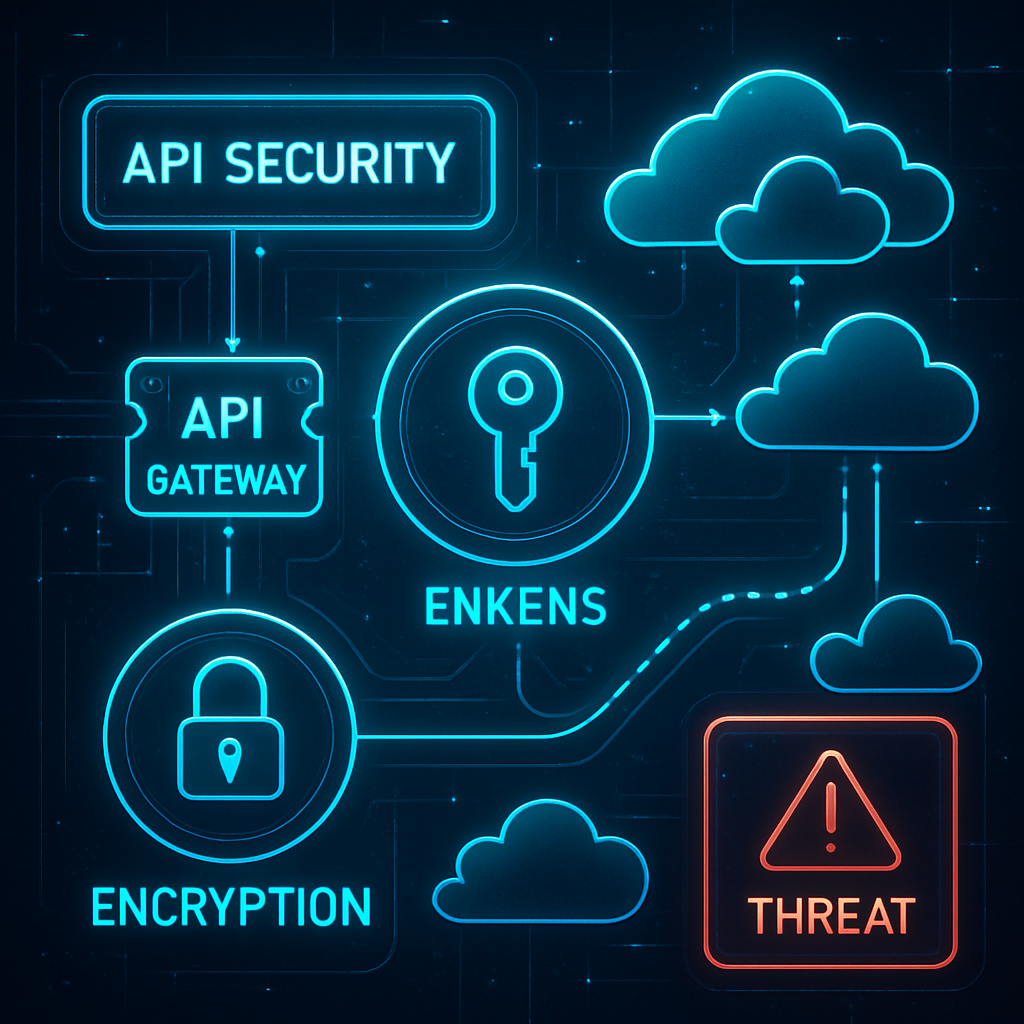
APIs are the connective tissue of modern software. They power mobile apps, partner integrations, and internal microservices. That reach also makes them a prime target: a single overlooked endpoint can expose sensitive data or disrupt critical workflows. This checklist walks you through API security from the first design conversation to production deployment—so you can ship fast without gambling on safety.
Whether you’re building your first API or hardening a mature platform, use the steps below to design securely, validate thoroughly, and operate with confidence.
Table of Contents
- Why API Security Matters
- Core Principles and Common Threats
- Secure-by-Design: Plan Before You Code
- Development Phase Checklist
- Testing and Validation
- Pre-Production Hardening
- Deployment and Runtime Protections
- Monitoring, Logging, and Incident Response
- Governance and Compliance Essentials
- Ongoing Operations and Continuous Improvement
- Tools and Automation (Optional)
- Conclusion
- Frequently Asked Questions
Why API Security Matters
APIs expand your product’s footprint and your attack surface. Misconfigurations, over-privileged tokens, or leaky debug endpoints can lead to data breaches and outages that are costly to fix and harder to rebuild trust from.
Good API security protects confidentiality, integrity, and availability while enabling speed. A practical checklist converts big goals into actions you can verify at every stage of delivery.
Core Principles and Common Threats
Security Principles to Anchor Your Decisions
- Least privilege: Grant only the minimal access required, to users and services.
- Defense in depth: Combine controls—authentication, authorization, input validation, network segmentation, and monitoring.
- Secure by default: Prefer safe defaults, opt-in to risky behavior only when necessary.
- Zero trust mindset: Authenticate and authorize every call; do not rely on network location alone.
Threats You Should Expect
- Broken authorization (object- and function-level), leading to data exposure.
- Broken authentication and session mismanagement.
- Excessive data exposure and mass assignment via permissive binding.
- Injection (SQL, NoSQL, command), SSRF, and deserialization issues.
- Replay, credential stuffing, brute force, and abuse of unauthenticated endpoints.
- Misconfigured CORS, verbose errors, and insecure defaults in gateways or proxies.
Familiarize your team with resources like the OWASP API Security Top 10 to prioritize risk.
Secure-by-Design: Plan Before You Code
Map the Surface
- List all consumers (mobile, web, partners, internal services) and trust boundaries.
- Classify data each endpoint handles (public, internal, confidential, regulated).
- Define rate expectations and abuse scenarios (e.g., enumeration, scraping).
Threat Model Early
- Identify threats (spoofing, tampering, information disclosure, DoS) and mitigations.
- Decide on authentication patterns (OAuth 2.1/OIDC for users, mTLS or client credentials for services).
- Choose token formats (opaque vs JWT) and lifetimes; align scopes with least privilege.
Design for Safety and Operability
- Version your API and plan deprecation to avoid insecure legacy endpoints.
- Define idempotency for unsafe methods (POST with idempotency keys) to prevent replay damage.
- Return standardized, sanitized errors; avoid leaking stack traces or internal IDs.
- Schema-first design (OpenAPI/JSON Schema) to enable validation and contract testing.
Development Phase Checklist
Authentication and Authorization
- Enforce TLS 1.2+ end-to-end; prefer TLS 1.3 where possible.
- Use a centralized identity provider for OAuth 2.1/OIDC; validate issuers, audiences, and expiration.
- Implement fine-grained authorization (RBAC/ABAC) and object-level checks on every request.
- Prefer short-lived access tokens; refresh via secure flows; rotate keys regularly.
Input, Output, and Data Handling
- Validate all inputs against schemas; reject unknown fields to prevent mass assignment.
- Apply server-side validation and context-aware output encoding.
- Minimize data returned—default to least data, support sparse fieldsets and pagination.
- Encrypt sensitive data at rest with a managed KMS; avoid custom crypto.
Secrets and Configuration
- Never hardcode secrets; store them in a secrets manager and load at runtime.
- Separate config from code; use environment-based configuration and config-as-code.
- Implement automated rotation for keys, tokens, and database credentials.
Reliability and Abuse Protections
- Implement rate limiting, quotas, and burst control per API key, token, or client.
- Set timeouts, retries with backoff, and circuit breakers to avoid cascading failures.
- Protect file upload endpoints: limit size, content type, and scan for malware.
HTTP and Caching Controls
- Set Strict-Transport-Security (HSTS) and X-Content-Type-Options where applicable.
- Use Cache-Control headers to prevent caching of sensitive responses.
- Configure CORS narrowly—explicit allowed origins, methods, and headers. Avoid wildcards for credentials.
Observability by Design
- Emit structured logs with correlation IDs; avoid logging secrets or full tokens.
- Define security events to log (auth failures, permission denials, schema violations).
- Expose health/readiness endpoints that reveal minimal information.
Testing and Validation
Automated Security Testing
- Static Application Security Testing (SAST) in CI to catch insecure patterns.
- Software Composition Analysis (SCA) to track and patch vulnerable dependencies, with an SBOM.
- Dynamic testing (DAST/API scanners) against staging; include negative tests and auth flows.
- Fuzz testing on parsers and critical endpoints to uncover edge-case crashes and injection.
Contract and Authorization Testing
- Use contract tests from OpenAPI to validate request/response schemas.
- Test object-level authorization paths explicitly: user A must not access user B’s resources.
- Verify pagination, filtering, and sorting cannot be abused to enumerate data.
Manual and Adversarial Testing
- Run security reviews for new endpoints and high-risk changes.
- Perform targeted manual testing for BOLA, mass assignment, and IDOR.
- Consider red team or third-party assessments for critical launches.
Pre-Production Hardening
Environment and Config
- Keep staging and production configurations as similar as possible; disable debug features everywhere.
- Ensure infrastructure least privilege: scoped IAM roles, service accounts, and network policies.
- Verify database hardening: strong auth, encryption at rest, least privilege per schema/table.
Edge and Gateway Policies
- Enforce authentication and schema validation at the gateway where possible.
- Apply global rate limits, bot detection, and IP reputation controls carefully to avoid blocking legit clients.
- Normalize requests (headers, encodings) to reduce evasions.
Checklists Before Go-Live
- Review API inventory and disable or lock down unused versions and endpoints.
- Confirm logging, metrics, and alerts are wired to the right dashboards and on-call rotations.
- Run a final secrets audit: repo scans, container scans, and environment checks.
Deployment and Runtime Protections
Container and Supply Chain
- Use minimal base images, run as non-root, and drop unnecessary Linux capabilities.
- Scan images pre-deploy; sign and verify images to protect the supply chain.
- Enforce IaC scanning for security misconfigurations in Terraform/Kubernetes.
Network and Transport
- Terminate TLS at a trusted edge and re-encrypt to services; consider mTLS for service-to-service calls.
- Restrict egress, apply network policies, and segment sensitive services.
- Use a service mesh for consistent mTLS, retries, and telemetry if complexity warrants it.
Runtime Controls
- Rate limit and throttle at both gateway and application layers.
- Enable request/response size limits; sanitize headers; block dangerous content types.
- Apply WAF/API security rules tuned for your schemas to reduce false positives.
Monitoring, Logging, and Incident Response
What to Measure and Alert
- Track authentication failures, permission denials, 4xx/5xx spikes, latency, and saturation.
- Alert on anomaly patterns (sudden rate surges, enumeration-like access, token misuse).
- Create dashboards per API with SLOs and clear error budget policies.
Logging and Forensics
- Centralize logs; use structured formats with request IDs. Redact PII and secrets.
- Preserve audit trails for sensitive actions with tamper-resistant storage.
- Define retention aligned to legal and operational needs.
Incident Readiness
- Maintain runbooks for token revocation, key rotation, and rapid endpoint disablement.
- Practice incident simulations and post-incident reviews to improve response.
- Have a clear communication plan for customers and partners.
Governance and Compliance Essentials
Policies and Standards
- Adopt coding and review standards that include security gates (e.g., checklists for auth, validation, logging).
- Maintain an API catalog with data classifications and owners for every endpoint.
- Track third-party dependencies and services with a complete SBOM and risk register.
Privacy and Regulations
- Apply data minimization and purpose limitation; avoid collecting what you won’t use.
- Support subject rights requests where applicable; design for deletion and retention controls.
- Conduct impact assessments for high-risk data flows.
Ongoing Operations and Continuous Improvement
Patch and Upgrade Cadence
- Keep runtimes, frameworks, and libraries updated; automate dependency updates with guardrails.
- Define SLAs for vulnerability remediation based on severity and exploitability.
Feedback Loops
- Establish a security champions network in engineering teams.
- Run periodic threat modeling refreshes as features and integrations evolve.
- Operate a responsible disclosure or bug bounty program if appropriate.
Lifecycle Management
- Document and communicate version deprecations; disable legacy endpoints on schedule.
- Regularly review API keys and client apps; remove stale credentials.
Tools and Automation (Optional)
Pipeline Automation
- CI: linting, unit/integration tests, SAST, SCA, OpenAPI validation.
- Pre-prod: DAST/API scans, fuzzing, performance and abuse simulations.
- CD: policy checks (e.g., OPA), image signing/verification, change approvals.
Platform Components
- API gateway or management platform for auth, quotas, analytics, and developer keys.
- Secrets manager and KMS for key custody and rotation.
- Central logging and SIEM for detection and correlation.
Conclusion
An API is only as strong as its weakest endpoint. By designing with security in mind, validating thoroughly in CI/CD, and enforcing protections at the edge and runtime, you dramatically reduce risk while preserving developer velocity.
Use this checklist as a living artifact. Revisit it at each release, during architecture changes, and after incidents. Small, consistent improvements compound into resilient, trustworthy APIs.
Frequently Asked Questions
What’s the difference between authentication and authorization?
Authentication verifies who the caller is (identity). Authorization checks what that caller is allowed to do (permissions). You need both on every request.
Are JWTs safer than opaque tokens?
Neither is inherently safer. JWTs allow stateless validation but require careful key management and claim validation. Opaque tokens centralize validation at the issuer. Choose based on your architecture and revocation needs.
When should I use mTLS?
Use mTLS for service-to-service calls where you control both ends. It provides strong mutual authentication and can complement, not replace, application-layer authorization.
Do I need an API gateway?
While not mandatory, a gateway simplifies consistent auth, rate limiting, schema validation, analytics, and central policy enforcement—especially at scale.
Leave a Reply