
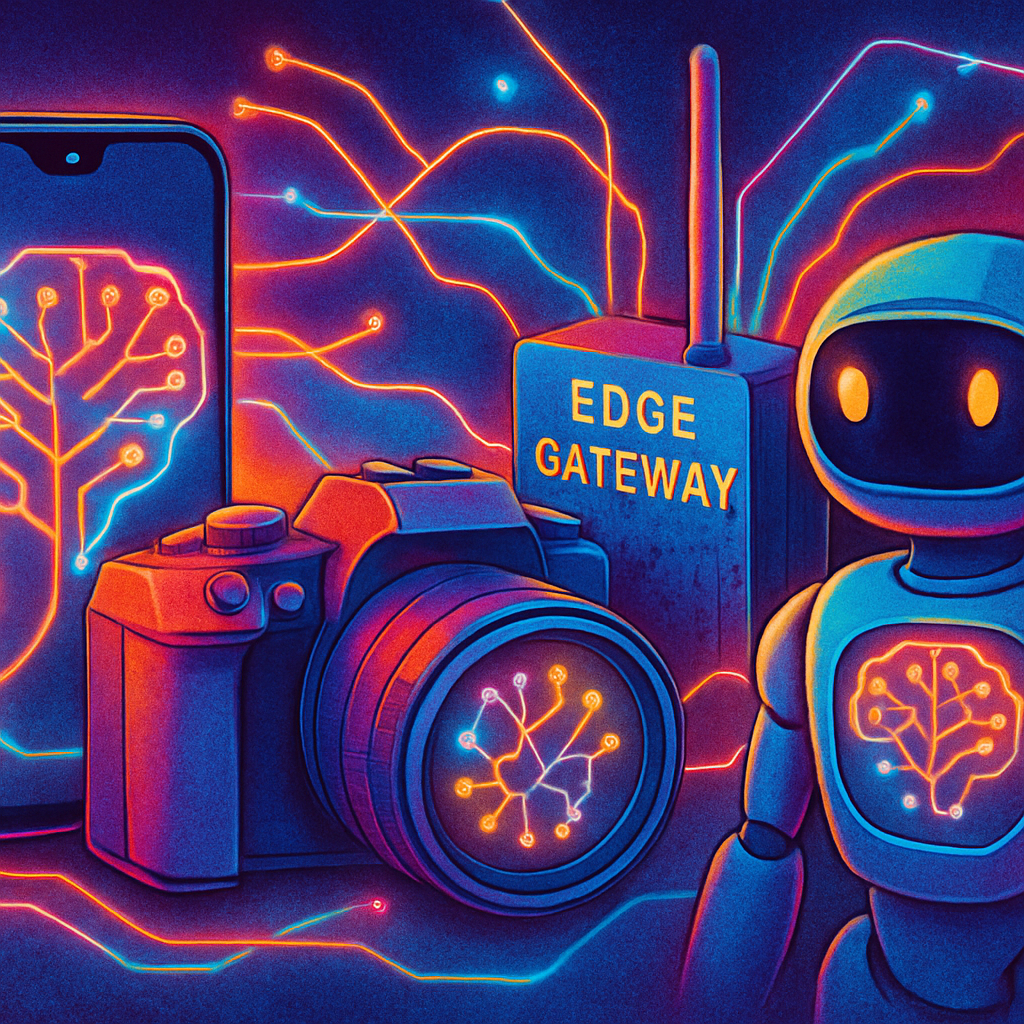
Open your phone camera and it can now recognize objects in real time. A factory sensor predicts a motor failure seconds before it happens. A car understands the road without waiting for a data center response. These moments feel instant because the intelligence runs close to where data is created—at the edge. This is Edge AI, and it is reshaping how we design experiences, operate systems, and build resilient, private, and low-latency applications.
For a general audience, this guide demystifies Edge AI in clear terms. We will cover what it is, why it matters, the industries adopting it, the technologies powering it, the challenges you should expect, and the best practices that help projects move from pilot to production.
Table of Contents
- What Is Edge AI?
- Why Edge AI Matters
- Key Opportunities Across Industries
- Core Technologies Enabling Edge AI
- Architecture Patterns and Deployment
- Challenges and Trade-offs
- Best Practices for Building Edge AI
- Measuring ROI and Success
- Emerging Trends and Future Outlook
- Conclusion
- Frequently Asked Questions
What Is Edge AI?
Edge AI is the practice of running artificial intelligence models directly on devices such as smartphones, sensors, industrial gateways, cameras, vehicles, point-of-sale terminals, and microcontrollers. Instead of sending raw data to a distant cloud for processing, Edge AI brings inference—and sometimes training—close to where data is generated.
How Edge AI differs from traditional cloud AI
- Data location: Edge AI processes data locally; cloud AI processes data centrally.
- Latency: Edge inference is near-instant; cloud round trips add variable delay.
- Bandwidth: Edge reduces continuous uplink of heavy data like video or audio.
- Privacy: Sensitive data can remain on the device, minimizing exposure.
- Resilience: Local intelligence keeps working through network hiccups.
Typical edge devices
- Consumer: phones, wearables, smart speakers, AR/VR headsets, home hubs
- Industrial: PLCs, gateways, rugged PCs, autonomous robots, machine vision cameras
- Automotive: ADAS ECUs, in-cabin monitoring systems, infotainment units
- Healthcare: portable diagnostics, bedside monitors, surgical tools
- Retail: self-checkout kiosks, smart shelves, digital signage
Why Edge AI Matters
Edge AI improves experiences, compliance, and costs. These benefits often compound when combined in a single workflow.
- Real-time responsiveness: Millisecond decisions power safety-critical use cases, fluid UX, and precise process control.
- Privacy by default: Keeping data on-device reduces exposure and simplifies compliance with regulations and customer expectations.
- Bandwidth savings: Pre-filtered or summarized data means lower connectivity costs and smoother operation in poor networks.
- Resilience and uptime: Systems continue operating during outages, with sync to cloud when connectivity returns.
- Personalization: Models tuned to a device or user context improve relevance without mass data aggregation.
- Cost efficiency: Less cloud compute and storage for raw streams can reduce total cost of ownership over time.
Key Opportunities Across Industries
Consumer and mobile
Smartphones and wearables already run on-device vision, speech, and recommendation models. Edge AI enhances camera features, health tracking, accessibility, and offline assistants that respond instantly while protecting user data.
- On-device transcription and translation for travel and accessibility
- Photo enhancement, object recognition, and AR try-ons
- Personalized notifications driven by local context like location and motion
Industrial and IoT
In factories, milliseconds matter. Edge AI drives predictive maintenance, quality inspection, and autonomous material handling—without saturating networks.
- Machine vision for defect detection on production lines
- Vibration analysis to predict bearing failures before downtime
- Robotics and cobots coordinating safely beside human workers
Automotive and mobility
Vehicles rely on edge processing for perception, planning, and driver assistance. Cabin-facing models personalize infotainment and monitor attention for safety.
- Real-time object detection, lane keeping, and collision avoidance
- Driver monitoring to detect drowsiness or distraction
- Predictive diagnostics to plan service before critical faults
Healthcare
Edge AI can bring smarter care closer to patients while respecting privacy. Devices analyze biosignals locally and trigger alerts without uploading sensitive data.
- ECG arrhythmia detection on wearable patches
- Ultrasound guidance with on-probe inference for point-of-care exams
- Patient monitoring that prioritizes critical alerts and compresses the rest
Retail and smart spaces
Stores and venues use edge vision and sensors to optimize flow, reduce theft, and personalize experiences on digital signage—all with minimal raw video leaving premises.
- Queue length detection and dynamic staff allocation
- Planogram compliance and shelf-stock alerts
- Contextual content on displays based on in-store activity
Smart cities and energy
Cameras, meters, and controllers at intersections, substations, and buildings make real-time decisions that improve safety and efficiency.
- Traffic signal optimization based on live flows
- Grid edge analytics for demand response and fault detection
- Building automation that adapts to occupancy and weather
Core Technologies Enabling Edge AI
Specialized hardware accelerators
Modern edge devices integrate compute tailored for AI tasks. Dedicated NPUs, DSPs, GPUs, FPGAs, and efficient CPUs deliver high throughput within tight power and thermal budgets.
- Mobile and embedded SoCs with integrated neural engines
- Edge modules and gateways with GPU or accelerator cards
- Ultra-low-power microcontrollers for tinyML on batteries
Model optimization techniques
To fit models on constrained devices without sacrificing accuracy, teams apply efficient architectures and compression.
- Quantization: Reduce precision (for example, 8-bit) for speed and memory savings.
- Pruning and sparsity: Remove redundant weights and exploit sparse compute.
- Knowledge distillation: Train a compact student to mimic a larger teacher.
- Neural architecture search: Discover models optimized for edge constraints.
On-device learning and federated approaches
Some scenarios benefit from continual adaptation. Devices can fine-tune models locally or participate in federated learning, where updates—not raw data—are aggregated to improve a global model while preserving privacy.
Edge-cloud orchestration
Edge AI rarely exists in isolation. The cloud still provides coordination for model versioning, policy, metrics aggregation, and heavy training. Smart orchestration decides what runs where, balancing latency, cost, and privacy.
MLOps for the edge
- Portable model formats and runtimes (for example, ONNX, TensorRT, Core ML, NNAPI)
- Containerization and lightweight orchestration on gateways
- Over-the-air updates with staged rollouts and rollback
- Remote telemetry, drift detection, and alerting
Architecture Patterns and Deployment
On-device inference
All critical inference runs on the device. The cloud provides model distribution and telemetry. This suits safety-critical, private, or offline-first use cases.
Edge gateway or micro data center
Multiple sensors stream to a nearby gateway with more compute. The gateway runs heavier models and returns decisions within the local network.
Hybrid split processing
Lightweight models run locally to filter or pre-classify data. Only uncertain cases or summaries go to the cloud for deeper analysis or labeling, reducing cost while maintaining accuracy.
Data pipelines and event-driven design
Edge applications benefit from message buses and buffering. Devices publish events; gateways and services subscribe, transform, and act. Back-pressure and retry logic preserve stability under variable links.
Deployment stages
- Prototype with a baseline model and known hardware.
- Profile latency, throughput, thermals, and memory under real load.
- Optimize models and pipelines; iterate until targets are met.
- Plan observability: logs, metrics, and on-device counters.
- Roll out gradually with canaries and A/B testing, then scale.
Challenges and Trade-offs
- Compute and memory limits: Constrained devices require compact models and careful scheduling. Aggressive optimization can impact accuracy.
- Power and thermal budgets: Sustained high utilization drains batteries and throttles chips. Duty cycling and efficient ops matter.
- Data privacy and governance: Keeping data local helps, but you still need consent, retention policies, and secure update mechanisms.
- Security and trust: Devices in the wild face physical and network threats. Secure boot, encryption, attestation, and signed updates are essential.
- Model drift and performance decay: Real-world conditions evolve. Continuous monitoring and scheduled refresh keep outcomes reliable.
- Heterogeneous hardware: Different accelerators and runtimes complicate portability. Abstraction layers and standardized formats reduce friction.
- Operational complexity at scale: Thousands of devices mean version skew, intermittent networks, and partial failures. Robust fleet management is key.
Best Practices for Building Edge AI
1) Start with the job to be done
Write a crisp problem statement and success criteria. Define target latency, accuracy, battery life, and privacy requirements up front.
2) Choose the right hardware and runtime
Match model complexity to compute, memory, and power budgets. Validate that your chosen runtime supports needed operators and accelerators.
3) Optimize early and often
- Design with efficient backbones suited to the edge.
- Apply quantization-aware training to preserve accuracy.
- Use pruning and distillation to shrink models without major losses.
4) Engineer for privacy and security
- Minimize collection of personally identifiable information.
- Process sensitive data locally; transmit only aggregates or embeddings.
- Implement secure key storage, signed models, and encrypted channels.
5) Test in the real world
Lab metrics rarely tell the full story. Evaluate under varied lighting, noise, motion, and network conditions. Record edge cases to improve datasets.
6) Plan observability and feedback
- Collect device-side metrics such as inference time, confidence, and temperature.
- Monitor drift via proxy signals like rising uncertainty or anomaly rates.
- Close the loop with curated samples for retraining.
7) Manage the model lifecycle
Version everything: data, models, and configs. Stage deployments, roll back fast, and automate updates. Treat edge devices as part of your MLOps platform.
Measuring ROI and Success
A solid business case connects model outcomes to financial impact. Combine technical metrics with operational and economic measures.
- Latency and throughput: P95 or P99 response times under peak load, frames per second, and time to first decision.
- Accuracy in context: Task-specific metrics (for example, precision, recall) measured on live distributions, not just test sets.
- Uptime and autonomy: Percentage of time meeting targets without cloud assistance.
- Bandwidth savings: Reduction in data egress versus baseline, converted into monthly cost savings.
- Operational efficiency: Downtime avoided, defects prevented, or labor hours saved per site.
- Total cost of ownership: Hardware, maintenance, connectivity, and cloud costs compared to centralized alternatives.
Emerging Trends and Future Outlook
Edge AI is moving fast, with innovations that push more capability into smaller, safer, and greener footprints.
- TinyML and extreme efficiency: Sub-milliwatt inference brings intelligence to disposable sensors and wearables.
- Multimodal on-device AI: Combining audio, vision, and motion improves robustness and context awareness.
- Generative AI at the edge: Compact language and vision-language models enable offline assistance and creativity on devices.
- Smarter networks: 5G and beyond bring compute closer to users, enabling collaborative edge-cloud processing.
- Security and governance by design: Hardware roots of trust, confidential compute, and stronger standards raise the baseline.
- Sustainable AI: Efficiency gains reduce energy use and lifecycle emissions across fleets of devices.
Conclusion
Edge AI brings intelligence to the point of action, unlocking fast, private, and resilient experiences across industries. The opportunity is significant—but so are the engineering and operational challenges. With the right hardware choices, model optimization, privacy-first design, and disciplined MLOps, teams can move from promising pilots to durable, large-scale impact.
If you are exploring Edge AI, start small with a high-value use case, measure relentlessly, and iterate. The combination of local intelligence and smart orchestration will define the next generation of responsive products and systems.
Frequently Asked Questions
Is Edge AI replacing cloud AI?
No. Edge and cloud are complementary. The edge handles real-time, private, and offline needs, while the cloud provides heavy training, global coordination, storage, and analytics.
How do I pick the right hardware for Edge AI?
Start from your workload targets: latency, accuracy, model size, power, and cost. Choose a device with an accelerator and runtime that supports your operators and can meet those targets under real conditions.
Can models be updated securely on edge devices?
Yes. Use signed model packages, secure boot, encrypted channels, and staged rollouts with rollback. Track versions and telemetry to ensure safe deployment.
What if my data changes over time?
Plan for drift. Monitor proxy signals, collect representative samples, and retrain periodically. Consider federated learning or on-device adaptation where appropriate.
Leave a Reply