
A major outage does not wait until a business has a large IT department, a dedicated risk manager, or a perfect recovery plan. A ransomware attack, extended power failure, severe storm, supplier disruption, or sudden loss of key staff can interrupt a small company’s operations within minutes. The businesses that recover most effectively are usually not those with the biggest budgets; they are the ones that have practiced what to do next.
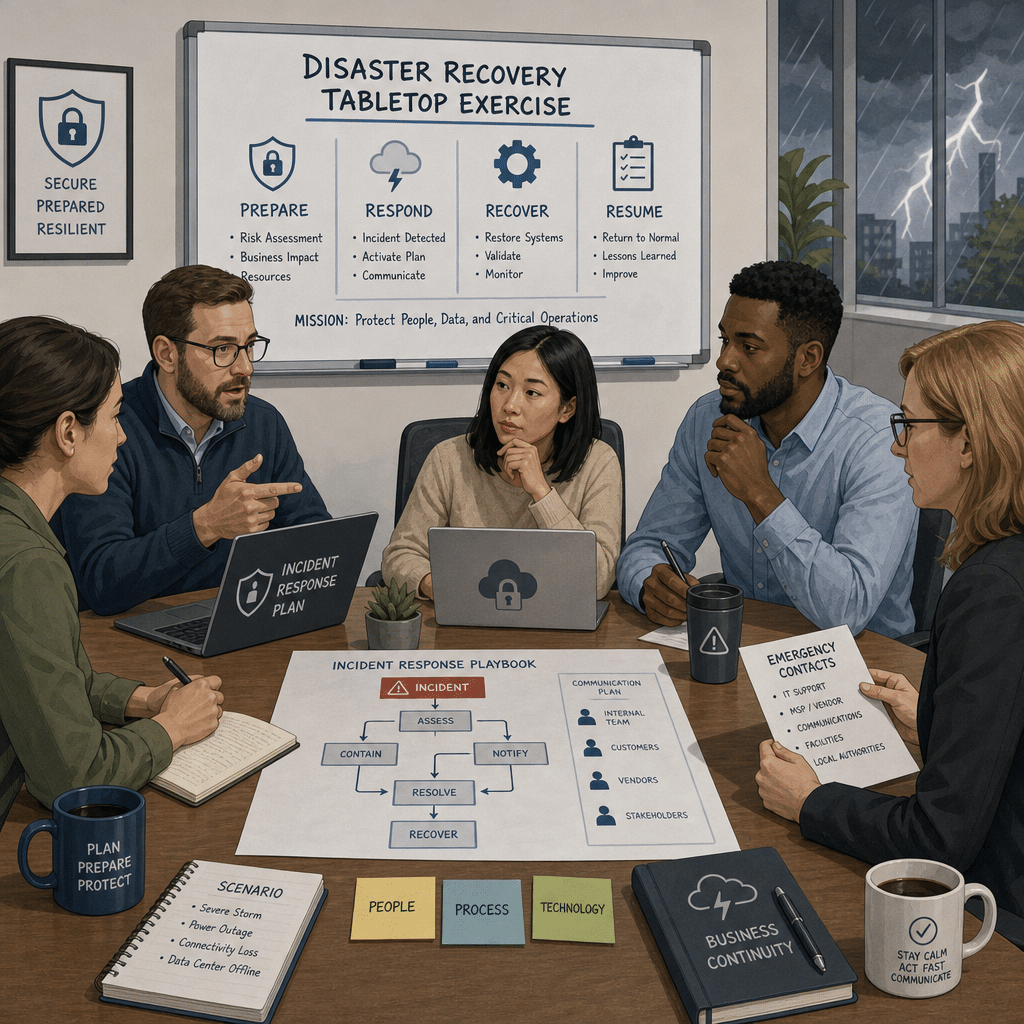
A disaster recovery tabletop exercise gives a small business a practical, low-cost way to test its response plans. Participants discuss a realistic incident, make decisions, and identify gaps without shutting down live operations. This guide explains how to run an exercise and provides a repeatable template that any small business can adapt.
Table of Contents
- Why Tabletop Exercises Matter
- How to Prepare for the Exercise
- A Practical Tabletop Exercise Template
- Disaster Recovery Scenarios to Test
- Questions That Reveal Gaps
- What to Do After the Exercise
- Conclusion
- Frequently Asked Questions
Why Tabletop Exercises Matter
A disaster recovery plan can look complete on paper but fail during a real emergency. Contact details may be outdated, employees may be unsure who has authority to make decisions, backups may not be usable, or essential suppliers may have no alternative. A tabletop exercise exposes these weaknesses while there is still time to correct them.
Unlike a technical recovery test, a tabletop exercise is primarily a guided conversation. A facilitator presents an incident in stages, and participants explain how they would respond. The aim is not to catch people making mistakes. It is to confirm that the business can make timely, coordinated decisions under pressure.
For small businesses, the benefits include:
- Clarifying emergency roles and decision-making authority.
- Testing communication with employees, customers, suppliers, and leadership.
- Checking whether critical data, applications, and equipment can be restored.
- Identifying dependencies on one person, vendor, location, or system.
- Creating a prioritized list of improvements that fit the available budget.
A useful exercise does not need expensive software or an elaborate conference room. It needs the right participants, a credible scenario, a structured discussion, and a commitment to act on the findings.
How to Prepare for the Exercise
Define the objective
Start with one or two clear objectives. For example, you may want to test how quickly your team can respond to a ransomware incident, verify that customer communication procedures work, or confirm that operations can continue if the main office is unavailable.
A narrow objective keeps the session manageable. Trying to test every part of business continuity in one meeting often produces a broad but shallow discussion.
Choose the right participants
Invite people who make decisions or perform essential tasks during a disruption. Depending on the business, this may include the owner or executive, operations lead, IT support, finance representative, human resources contact, communications lead, and a manager from a critical department.
Include external partners when appropriate, such as a managed service provider, cloud provider, insurance contact, or key supplier. If they cannot attend, document what information or assistance you would need from them.
Set the format and ground rules
Plan a 60- to 90-minute session. Hold it in person or through a video meeting, and appoint a facilitator who can keep the conversation focused. The facilitator should not dominate decisions or turn the session into a technical lecture.
Use these ground rules:
- The exercise is for learning, not blame.
- Participants should answer from current knowledge rather than assume an ideal future state.
- Uncertainty should be recorded instead of ignored.
- Real incidents and sensitive information should be handled carefully.
- Every significant gap should have an owner and a target date after the exercise.
Gather essential documents
Bring the current disaster recovery plan, business continuity plan, emergency contact list, asset inventory, vendor contacts, insurance information, backup policy, and relevant cybersecurity procedures. Do not delay the exercise because one document is missing. The absence of a document may itself be an important finding.
A Practical Tabletop Exercise Template
The following structure can be copied into a meeting agenda or exercise worksheet. Adjust the scenario and questions to match the size and complexity of your organization.
1. Exercise information
- Exercise name: Choose a clear name, such as “Ransomware Response Test.”
- Date and duration: Record when the exercise will take place and how long it will run.
- Facilitator: Name the person guiding the discussion.
- Participants: List attendees and their business roles.
- Primary objective: State what the exercise is intended to test.
- Scope: Note the departments, locations, systems, and processes included.
2. Scenario briefing
Present a short, realistic opening scenario. Avoid giving participants every detail at once. The facilitator should release information in stages so the group has to prioritize, communicate, and make decisions as a real incident develops.
Example opening: It is 8:15 a.m. on a normal business day. Employees report that they cannot access shared files or the customer management system. Several computers display a message claiming that company data has been encrypted. The IT support provider is not immediately answering.
After the group discusses the first response, introduce additional developments:
- A backup system shows signs of unusual activity.
- Customers begin asking why orders or services are delayed.
- An employee reports that a suspicious email was opened the previous afternoon.
- A critical supplier needs confirmation about payment or delivery.
- Local media asks whether customer information was exposed.
3. Initial response discussion
Ask participants to describe the first 15 to 30 minutes. Focus on actions, ownership, and communication rather than speculation about the exact cause.
- Who declares that an incident is underway?
- Who has authority to disconnect systems, pause transactions, or close a location?
- How will the team contact one another if email is unavailable?
- What systems or business processes are most critical?
- What evidence must be preserved before devices are changed or restored?
- Who records decisions, times, and outstanding questions?
4. Continuity and recovery discussion
Next, ask how the business will continue operating over the next day, week, or longer. Participants should identify temporary workarounds as well as the conditions required to return to normal operations.
- Which services must be restored first?
- Can employees work from another location or use approved alternate devices?
- Where are current customer, supplier, payroll, and financial records stored?
- How long can the business operate without each critical system?
- Are backups available, protected, and tested?
- Who approves restoration, and how will the business verify that systems are safe?
- What manual process will be used if automated systems remain unavailable?
5. Communications discussion
Communication failures can increase the damage caused by an incident. Have participants draft the basic message they would send to employees, customers, suppliers, and other stakeholders. The messages do not need to contain every technical detail; they should be accurate, timely, and consistent.
Confirm who is authorized to communicate externally. Also decide how often updates will be provided, where employees can find official information, and how the organization will respond if facts are incomplete.
6. Exercise closeout
End by asking each participant to state one thing that worked, one uncertainty they noticed, and one improvement the business should make. The facilitator should summarize the main decisions, unresolved issues, and assumptions that need verification.
Disaster Recovery Scenarios to Test
A good scenario reflects the risks your business is most likely to face and the consequences that would matter most. Consider rotating scenarios during the year rather than repeating the same discussion.
Cyberattack or ransomware
Test whether employees know how to report suspicious activity, whether accounts can be disabled quickly, and whether backups are isolated from production systems. Include questions about legal advice, cyber insurance, customer notifications, and evidence preservation.
Severe weather or facility loss
Assume the main workplace is inaccessible because of flooding, fire, a storm, or a building system failure. Explore remote work, alternate locations, physical records, equipment replacement, employee safety, and access to cash or payment systems.
Critical vendor outage
Consider the failure of a payment processor, internet provider, cloud platform, logistics company, or specialized supplier. Determine whether the business has an alternative provider, a manual workaround, and a clear process for escalating the issue.
Loss of a key employee
Test what happens if the only person who understands payroll, a production system, customer accounts, or a regulated process is suddenly unavailable. This scenario can reveal the need for cross-training, documented procedures, shared credentials managed securely, and succession planning.
Questions That Reveal Gaps
During the exercise, encourage participants to ask practical questions instead of relying on general statements such as “IT will handle it.” Useful questions include:
- What does “critical” mean for this business, and who decided the priority?
- What is the maximum acceptable downtime for each important service?
- When was the last successful backup restoration test?
- Can employees access emergency contacts without company email?
- Which decisions require the owner’s approval, and who acts if the owner is unavailable?
- What information must never be shared through an unapproved channel?
- How will we pay employees, suppliers, and emergency contractors?
- What customer promises may be affected, and who will manage expectations?
- Which regulator, insurer, law enforcement agency, or professional adviser may need to be contacted?
- What signs will tell us that recovery is complete and normal operations can resume?
Pay particular attention to answers that begin with “I think,” “probably,” or “someone else has that.” These phrases are not failures, but they identify issues that require confirmation and documentation.
What to Do After the Exercise
The value of a tabletop exercise depends on what happens after the meeting. Within a few days, prepare a short after-action report while details are fresh. Describe the scenario, participants, decisions made, strengths, gaps, and recommended improvements.
Rank findings according to business impact and urgency. A simple priority system works well:
- High: The gap could prevent the business from protecting people, meeting legal obligations, or restoring a critical operation.
- Medium: The gap could create significant delay, confusion, cost, or reputational harm.
- Low: The gap would improve efficiency or clarity but is unlikely to stop recovery.
Convert each finding into an action with an owner, deadline, required resources, and success measure. For example, “Improve backups” is too vague. “The IT lead will perform and document a full restoration test for the accounting system by June 30” is specific and verifiable.
Share appropriate findings with leadership and relevant employees. Avoid distributing sensitive security details more widely than necessary. Then schedule a follow-up review to confirm that corrective actions are complete.
Most small businesses should run a tabletop exercise at least annually and after major changes, such as adopting a new critical system, moving offices, changing vendors, or experiencing a real incident. Short, focused exercises can also be held quarterly to test individual capabilities such as emergency communications or backup restoration.
Conclusion
A disaster recovery tabletop exercise helps a small business replace assumptions with tested decisions. By using a realistic scenario, involving the right people, asking practical questions, and tracking corrective actions, you can improve resilience without interrupting normal operations.
Start with one priority risk and a 60-minute discussion. Use the template in this guide, document every uncertainty, and assign someone to resolve each important gap. The goal is not a flawless exercise; it is a business that is better prepared for the next unexpected disruption.
Frequently Asked Questions
What is a disaster recovery tabletop exercise?
It is a guided discussion in which participants respond to a simulated disruption. The exercise tests decisions, communication, roles, and recovery procedures without creating a real outage.
How long should a small-business tabletop exercise take?
Most sessions take 60 to 90 minutes. A shorter 30-minute exercise can work for a narrow objective, while a complex scenario may require multiple sessions.
Do we need an IT expert to run the exercise?
Not necessarily. A facilitator needs to guide the discussion and capture findings. An IT specialist should participate when the scenario involves technology, backups, cybersecurity, or system restoration.
What is the most important output from the exercise?
The most important output is an action plan that assigns each significant gap to a specific owner with a deadline and a measurable result. Discussion alone does not improve recovery capability.
Leave a Reply