
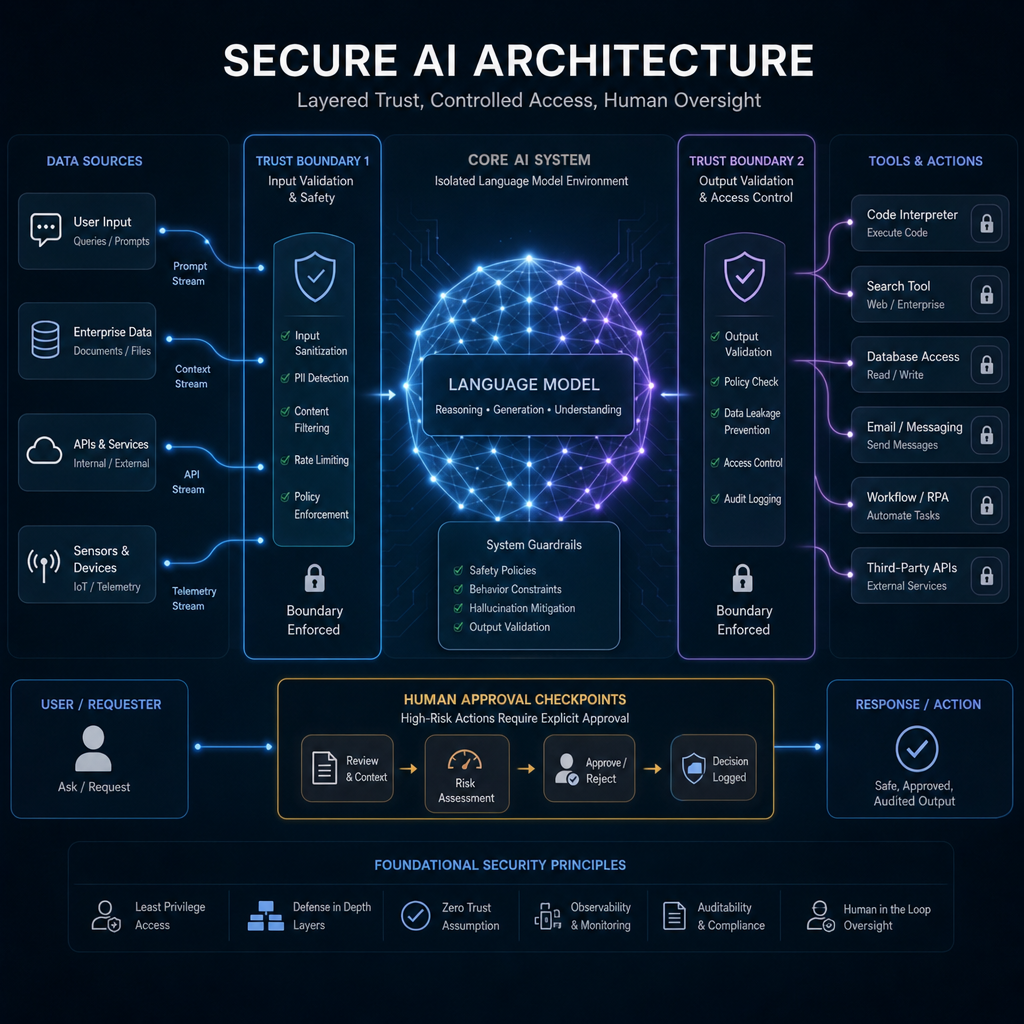
Large language models can summarize documents, answer questions, write code, and trigger actions in business systems. That versatility is also what makes them difficult to secure. An LLM application does not simply process trusted instructions; it often combines system prompts, user messages, retrieved documents, tool outputs, and external data in one conversational context.
This creates the trust boundary problem in LLM applications: the model may be unable to reliably distinguish instructions from information. A sentence hidden in an uploaded file can look like a command. A malicious webpage can influence a research agent. A user request can persuade an assistant to reveal data or perform an action beyond its authority.
This guide explains where trust boundaries break down, why traditional application security assumptions are not enough, and how teams can design safer LLM systems. The goal is not to eliminate useful AI behavior, but to place meaningful controls around what the model can see, decide, and do.
Table of Contents
- What a Trust Boundary Means in an LLM Application
- Why LLM Trust Boundaries Are Different
- Common Attack Paths
- Designing Safer LLM Architectures
- Practical Security Controls
- Testing and Monitoring the Boundary
- Building Security Into the Product
- Conclusion
What a Trust Boundary Means in an LLM Application
In traditional security, a trust boundary separates components with different levels of confidence or authority. For example, an application may treat its database as trusted, a logged-in user as partially trusted, and an anonymous internet request as untrusted. Data crossing the boundary is validated, constrained, or filtered before it reaches a sensitive component.
LLM applications have several overlapping boundaries. The model may receive instructions from a developer, content from a user, text retrieved from a knowledge base, and results returned by a tool. These inputs do not have equal authority, but they may appear together in the same context window.
The central risk is that the model processes language rather than enforcing a formal security hierarchy. A model can be told that a system instruction is more important than a user message, but it is not a security policy engine in the traditional sense. It predicts useful responses based on context, and attackers can exploit that behavior.
Trust is not the same as relevance
Retrieved content may be relevant to a question without being trustworthy. A customer email may contain useful facts but also contain instructions aimed at manipulating the assistant. Likewise, a web page can provide accurate product information while embedding text that tells an agent to ignore its rules.
Applications must therefore distinguish at least three properties: who supplied the data, whether the data is allowed to influence behavior, and what actions may follow from it. Treating all relevant text as trusted instructions is a design error.
Why LLM Trust Boundaries Are Different
Conventional software usually separates code from data. A string stored in a database does not normally rewrite the program’s logic. In an LLM application, however, natural-language data can influence the model’s next decision. Instructions and ordinary content use the same medium: tokens in a prompt.
This makes the boundary both dynamic and difficult to inspect. A malicious instruction can be obvious, subtle, encoded, translated, or distributed across several documents. It may also exploit the model’s helpfulness, asking it to follow a seemingly reasonable process that leads to an unsafe result.
Multiple sources create ambiguity
A typical agent might receive a system policy, a user question, search results, a memory record, and tool output. Each source can contain conflicting requests. If the application does not explicitly label and constrain these sources, the model must infer which instructions matter most.
Tools turn language into consequences
A chatbot that only generates text has a limited blast radius. An agent with access to email, payments, customer records, or deployment systems can convert a mistaken interpretation into a real-world event. The trust boundary therefore extends beyond the prompt to every tool and permission available to the model.
Common Attack Paths
The most important risks are not limited to a single prompt-injection technique. They arise whenever untrusted content can influence a model that has access to sensitive information or powerful actions.
Direct prompt injection
In a direct attack, a user attempts to override the application’s intended behavior. They may ask the assistant to reveal hidden instructions, ignore restrictions, or role-play as a system administrator. Even when a model refuses one phrasing, variations can sometimes produce a different result.
Indirect prompt injection
Indirect injection occurs when an attack is stored in content the model later reads. Examples include a poisoned knowledge-base article, a malicious support ticket, a web page, or a document uploaded by a user. The user may not even know that the content contains instructions.
This attack is especially serious for retrieval-augmented generation and autonomous agents. An agent may retrieve hostile text during a normal task, interpret it as guidance, and then use its tools to send data or alter records.
Data exfiltration
An attacker may try to make the model disclose system prompts, confidential retrieved passages, customer information, credentials, or internal reasoning. The attack can be direct, or it can exploit a tool that returns more information than the user is authorized to receive.
Unsafe tool use
If an agent can call tools based on free-form model output, an injection may cause it to send an email, delete a file, approve a refund, or execute code. The model’s confidence is not proof that the action is safe, and natural-language approval is a weak substitute for authorization.
Memory poisoning
Persistent memory creates another boundary. If an application saves unverified instructions or attacker-controlled facts, those items can influence future conversations. A one-time attack may become a long-term change in how the assistant behaves.
Designing Safer LLM Architectures
The strongest defense is architectural. Do not ask the model to be the only component deciding whether content is trustworthy or an action is permitted. Use the model for language interpretation, while deterministic application code enforces authority.
Separate instructions from data
Clearly label content by source and purpose. Keep system policies outside user-controlled fields, place retrieved material in a designated data section, and tell the model that quoted content is reference material rather than an instruction. This will not prevent every attack, but it reduces ambiguity.
Where possible, pass structured records instead of concatenating raw text into a single prompt. A document can be represented as fields such as title, author, date, and body. The application can then decide which fields are allowed to affect an operation.
Use least privilege
Give each agent only the tools and data required for its task. Read-only access is safer than write access, and access to one customer’s records is safer than access to an entire database. Short-lived credentials, scoped tokens, and separate service accounts limit damage when a model is manipulated.
Place policy enforcement outside the model
Before executing a tool call, validate the requested operation in application code. Check the user’s identity, resource ownership, allowed parameters, transaction limits, and required approvals. A model can propose an action, but a trusted policy layer should decide whether the action is authorized.
Require confirmation for high-impact actions
Use human confirmation for irreversible or sensitive operations, such as sending external messages, making purchases, deleting records, changing permissions, or publishing content. Confirmation should show the exact action and its important parameters, not merely ask whether the user wants to continue.
Practical Security Controls
Security controls should operate at several layers because no single filter is reliable against every form of manipulation.
- Input controls: authenticate users, limit input size, detect suspicious patterns, and separate user content from application instructions.
- Retrieval controls: apply document-level permissions before retrieval, maintain source provenance, and avoid returning content the user cannot access.
- Output controls: validate structured responses against a schema, redact sensitive data, and reject unexpected fields or commands.
- Tool controls: use allowlists, strict parameter validation, rate limits, timeouts, and transaction ceilings.
- Secret management: keep credentials outside prompts and never rely on the model to protect secrets included in its context.
- Human controls: add review steps, escalation paths, and clear explanations for decisions with material consequences.
Structured output is particularly useful. Instead of allowing the model to produce arbitrary code or an unrestricted API request, require a narrow object such as an action type, record identifier, and justification. The application can validate each field and reject anything outside the permitted set.
Be careful with prompt-based defenses
Instructions such as “never reveal confidential information” are useful guidance, but they are not a complete security boundary. They can be overridden, misinterpreted, or weakened by conflicting context. Treat prompts as one control among several, not as an access-control mechanism.
Testing and Monitoring the Boundary
LLM security testing should examine the whole workflow, not only the model’s response to a list of jailbreak prompts. Test how the application behaves when hostile text appears in every input channel: user messages, files, search results, memory, tool responses, and third-party content.
Build realistic attack scenarios
Create tests for data leakage, unauthorized tool use, privilege escalation, prompt extraction, malicious documents, and conflicting instructions. Include multilingual, encoded, indirect, and multi-turn variations. The objective is to discover whether untrusted content can cross into a sensitive decision.
Evaluate both false negatives and false positives. A system that blocks every uncertain request may be safe but unusable, while a system that completes every task may be productive but dangerous. Measure whether the application refuses correctly, requests clarification, and preserves legitimate workflows.
Log decisions without logging secrets
Record which tools were requested, which policies were applied, whether a human approved the action, and what result was returned. Avoid storing unnecessary personal data, credentials, or full sensitive prompts. Logs should support investigation while following privacy and retention requirements.
Monitor for drift
Models, prompts, retrieval indexes, tools, and user behavior change over time. Re-run security evaluations after model upgrades, prompt changes, new integrations, or changes to document sources. Trust boundaries need continuous testing because the application is a moving system.
Building Security Into the Product
The trust boundary problem is partly technical and partly organizational. Product teams should define what the assistant is allowed to do, what it must never do, and when a person must take over. These decisions should be documented before deployment rather than inferred from occasional model behavior.
Assign clear ownership for prompts, tool permissions, data access, incident response, and evaluation. Security, engineering, legal, privacy, and user-experience teams may all identify different failure modes. A cross-functional review is especially important when an LLM handles regulated data or acts on behalf of users.
Users also need understandable boundaries. Explain what information the assistant can access, when it uses external tools, and which actions require approval. Transparency helps people detect suspicious behavior and prevents them from assuming that a fluent answer is necessarily accurate or authorized.
Conclusion
The trust boundary problem in LLM applications exists because language can carry both information and instructions. A model may read untrusted content and treat it as guidance, especially when that model is connected to private data, external systems, or powerful tools.
Safer design requires layered defenses: separate data from instructions, enforce permissions outside the model, apply least privilege, validate tool calls, protect secrets, require confirmation for high-impact actions, and test every path through which content enters the system. The most reliable principle is simple: do not make the model the final authority over access or consequences.
As LLM applications become more capable, trustworthy systems will be those that make authority explicit. Start by mapping every input, tool, data source, and decision point, then place a verifiable control at each boundary.
Frequently Asked Questions
What is the trust boundary problem in LLM applications?
It is the difficulty of ensuring that an LLM treats instructions, user content, retrieved documents, and tool outputs according to their different levels of trust. Because all of them are represented as language, untrusted content may influence behavior.
Is prompt injection the same as a data breach?
Not always. Prompt injection is a manipulation technique, while a data breach is an unauthorized disclosure or access event. Prompt injection can cause a breach when it persuades an application to reveal protected information or misuse a tool.
Can a strong system prompt solve the problem?
No. A well-designed system prompt can reduce risk, but it cannot replace authentication, authorization, input handling, tool restrictions, output validation, and human review. Security-critical controls should be enforced by deterministic application code.
What is the best first step for securing an LLM agent?
Map its trust boundaries. List every source of content, every data store, every tool, and every action the agent can trigger. Then reduce permissions and add validation wherever untrusted content could influence a sensitive decision.
Leave a Reply