
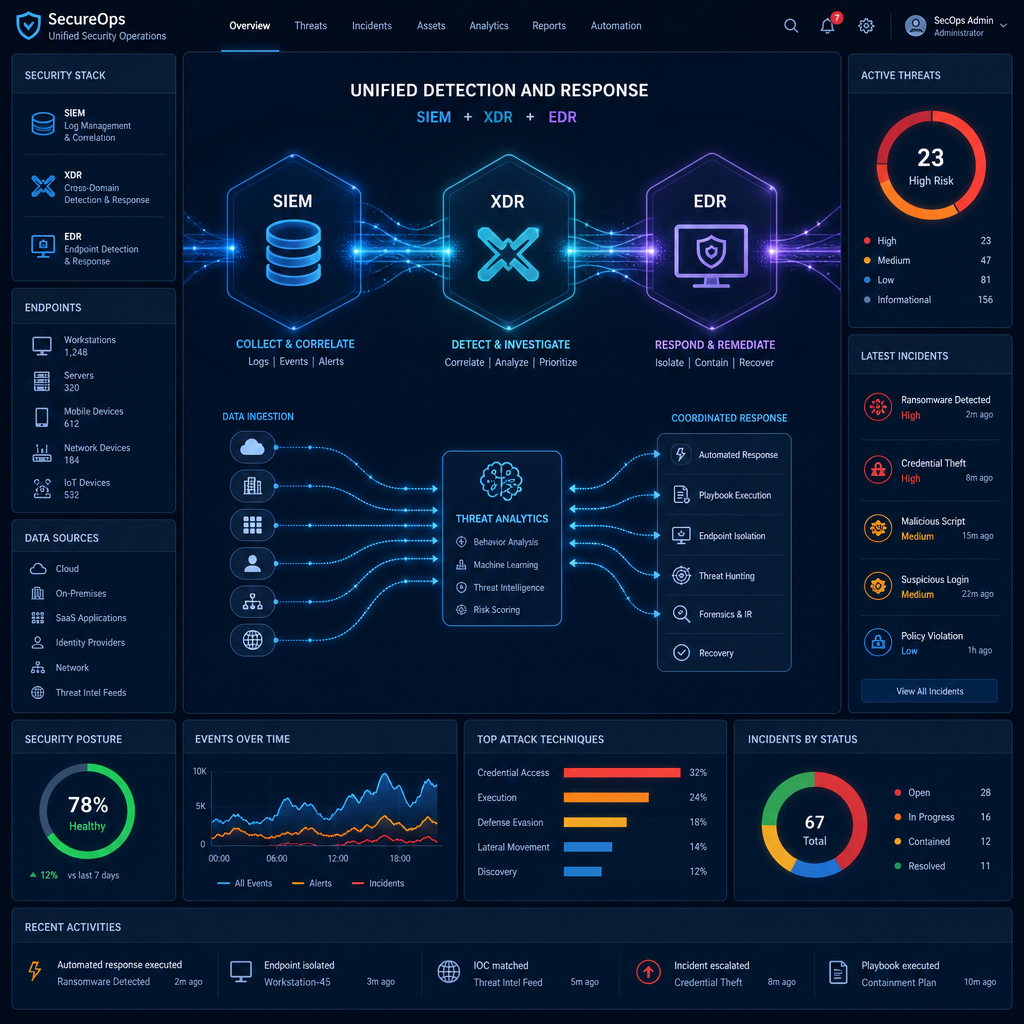
Security teams rarely lack security tools; they lack clarity about how those tools fit together. SIEM, XDR, and EDR platforms can all support detection and response, but they collect different data, solve different problems, and require different levels of staffing and investment. Choosing the wrong platform can create overlapping alerts, integration gaps, or an expensive system that the team cannot fully use.
This buyer’s checklist explains what to compare before selecting a platform. Whether you are building a security operations function, replacing legacy technology, or consolidating vendors, the goal is to match capabilities with your risks, operating model, and long-term security strategy.
Table of Contents
- Understand the Platform Differences
- Assess Your Security Requirements
- Compare Data and Visibility
- Evaluate Detection and Response
- Review Integrations and Architecture
- Compare Costs and Operations
- Run a Proof of Value
- Make the Final Decision
- Frequently Asked Questions
Understand the Platform Differences
Start with the basic role of each technology. Although product categories increasingly overlap, their primary purposes remain distinct.
SIEM: Broad security analytics
A security information and event management platform, or SIEM, collects and analyzes logs and security events from across an organization. It can bring together data from identity systems, cloud services, applications, network devices, endpoints, and other sources.
SIEM is typically strongest when you need centralized visibility, compliance reporting, historical investigation, custom detection rules, and correlation across multiple environments. Its breadth can also create complexity: data onboarding, storage, tuning, and query development may require significant expertise.
EDR: Deep endpoint protection
Endpoint detection and response, or EDR, focuses on laptops, servers, and other endpoint devices. An EDR agent records activity such as process execution, file changes, command-line use, network connections, and suspicious behavior.
EDR is valuable for investigating endpoint attacks and taking direct action, such as isolating a device, terminating a process, or quarantining a file. However, endpoint-focused visibility may not fully explain identity, SaaS, cloud, or network activity without additional integrations.
XDR: Connected detection and response
Extended detection and response, or XDR, correlates telemetry from multiple security domains, often including endpoints, email, identity, cloud, and network controls. Its purpose is to reduce fragmented investigations and present related activity as a connected incident.
XDR may be a strong choice for teams that want faster, more guided response with less manual correlation. Buyers should examine how open the platform is, because some XDR products work best within a specific vendor ecosystem while others support a broad range of third-party tools.
Assess Your Security Requirements
Do not begin with a feature comparison spreadsheet. Begin by documenting the outcomes the platform must deliver. A product can have an impressive feature list and still be a poor fit for your environment.
Answer questions such as:
- Which assets are most important to protect?
- What threats, attack techniques, or compliance requirements are most relevant?
- How quickly must the team detect, investigate, and contain an incident?
- How many analysts will operate the platform, and what is their experience level?
- Does the organization have staff available for 24/7 monitoring?
- Which systems must be supported on day one?
- Are you trying to improve visibility, reduce alert volume, accelerate response, or replace several tools?
Also identify your organization’s operating model. A small team may prioritize automation, managed services, and simple workflows. A large enterprise may need advanced hunting, granular access controls, extensive customization, and support for multiple business units.
Compare Data and Visibility
Detection quality depends heavily on the data a platform can access and retain. Ask vendors to describe not only their integrations, but also the specific fields, event types, enrichment, and retention options available for each integration.
Coverage and collection
Check whether the platform supports your operating systems, cloud providers, identity platforms, firewalls, email systems, business applications, and critical infrastructure. Determine whether collection is agent-based, agentless, API-driven, or dependent on forwarding logs through another system.
For EDR, evaluate the quality of endpoint telemetry and the impact of the agent on performance. For SIEM, examine the breadth and reliability of log ingestion. For XDR, verify whether the platform can correlate data from tools you already own rather than only data from the same vendor.
Retention and investigation
Ask how long raw and normalized data is retained, whether retention periods vary by data type, and what additional charges apply. Security investigations often require historical context, so a low initial price may become costly when longer retention or higher search capacity is added.
Review the search experience as well. Analysts should be able to pivot from an alert to related users, hosts, processes, domains, files, and authentication events without relying on several disconnected consoles.
Evaluate Detection and Response
Detection is only one part of the buying decision. A useful platform should help analysts understand what happened, determine the scope, and take appropriate action.
Detection capabilities
Compare behavioral analytics, rules, threat intelligence, machine learning, anomaly detection, and user or entity behavior analytics. Ask how detections are created and maintained. Can your team write custom rules? Can it import industry-standard content? How frequently are built-in detections updated?
Request examples of detections for realistic scenarios, such as stolen credentials, ransomware, suspicious PowerShell activity, cloud account abuse, data exfiltration, and lateral movement. Evaluate whether the system identifies a meaningful attack sequence or produces several unrelated alerts.
Investigation and prioritization
Look for incident timelines, alert grouping, asset and identity context, case management, and clear explanations of why an event was considered suspicious. A platform should help an analyst distinguish a genuine threat from a false positive without requiring extensive manual research.
Ask vendors to demonstrate alert suppression, deduplication, risk scoring, and prioritization. A high volume of alerts is not a sign of strong protection if analysts cannot determine which events deserve immediate attention.
Response and automation
Compare available response actions and the safeguards around them. Examples include isolating an endpoint, disabling an account, blocking an indicator, revoking a session, removing a malicious email, or creating a ticket for another team.
Automation should be flexible and auditable. Confirm whether workflows support approvals, rollback, role-based permissions, detailed logging, and different actions for different risk levels. Fully automatic containment may be appropriate for some scenarios but dangerous for others.
Review Integrations and Architecture
Integration quality often matters more than the number of integrations listed on a product page. A connector that only imports basic alerts may provide less value than a smaller integration with rich, bidirectional data and response actions.
Review the platform’s APIs, software development kits, webhooks, data formats, and workflow tools. Confirm whether it can send incidents to your ticketing, collaboration, vulnerability management, and orchestration systems. Also determine whether it can receive asset context, identity information, threat intelligence, and remediation status from those systems.
Architecture is equally important. Compare cloud-hosted, on-premises, and hybrid deployment options. Consider data residency, encryption, tenant separation, administrative access, uptime commitments, and how the platform handles remote endpoints and distributed cloud workloads.
Ask about vendor lock-in directly. If an XDR platform relies heavily on one vendor’s endpoint, identity, or email products, understand the benefits and limitations of that model. An integrated ecosystem can improve correlation and response, but an open architecture may better support a diverse technology environment.
Compare Costs and Operations
Compare total cost of ownership rather than only the subscription price. Pricing may be based on users, endpoints, data volume, events per second, monitored assets, features, or a combination of these measures.
Request a transparent estimate that includes:
- Licensing for the expected number of users, endpoints, and data sources.
- Data ingestion, indexing, search, and retention charges.
- Premium detection, automation, or threat intelligence features.
- Implementation, migration, training, and professional services.
- Managed detection and response or 24/7 monitoring services.
- Support tiers, renewal increases, and overage costs.
Then estimate the internal effort required. A platform that costs less but needs two additional full-time analysts may be more expensive overall. Conversely, a higher-priced platform may create value if it reduces investigation time, consolidates tools, and enables a small team to respond more effectively.
Usability and administration
Assess the daily experience for analysts, engineers, managers, and auditors. Important considerations include dashboard customization, report creation, search performance, rule management, alert tuning, role-based access, and change tracking.
Also evaluate onboarding. Ask how long it typically takes to connect important data sources, create useful detections, and reach stable alert volumes. A strong implementation plan should include ownership, milestones, tuning cycles, and success measures.
Run a Proof of Value
A proof of value is one of the best ways to move beyond vendor demonstrations. Use your own data and define success criteria before the evaluation begins.
Test representative scenarios, including an endpoint compromise, suspicious identity activity, a cloud configuration change, malware delivered by email, and a data access anomaly. Measure:
- Time required to onboard critical data sources.
- Detection accuracy and false-positive rates.
- Time to investigate and understand an incident.
- Number of consoles or manual steps required.
- Response actions available and time to containment.
- Search speed and historical investigation capabilities.
- Effort required to maintain rules, integrations, and workflows.
Include the people who will use the system. An executive may value reporting and risk visibility, while an analyst may focus on timelines, pivots, and response actions. IT, privacy, legal, and compliance stakeholders may have separate requirements for data handling and automated actions.
Make the Final Decision
Use a weighted scorecard rather than choosing the platform with the longest feature list. Assign greater weight to requirements that directly affect risk and operational success, such as critical asset coverage, response effectiveness, integration quality, and usability.
As a general guide, SIEM may be the best fit when centralized logging, broad visibility, compliance, and custom analytics are primary needs. EDR may be the right starting point when endpoint protection and rapid device-level response are the most urgent priorities. XDR may be preferable when you want correlated detection and guided response across several security domains.
These categories are not mutually exclusive. Many organizations use EDR as a foundational control, SIEM for long-term analytics and governance, and XDR to connect high-priority signals and automate response. The right combination depends on your environment, staff, risk tolerance, and existing investments.
Before signing, confirm implementation responsibilities, data ownership, exit terms, service-level commitments, roadmap transparency, and renewal pricing. The strongest purchase decision is not simply the platform with the most capabilities; it is the one your team can deploy, operate, measure, and improve consistently.
Conclusion
Comparing SIEM, XDR, and EDR platforms requires more than reviewing product brochures. Start with your security outcomes, then evaluate data coverage, detection quality, investigation workflows, response automation, integrations, operating effort, and total cost.
Use a realistic proof of value and involve the people who will operate the platform every day. With a disciplined checklist, you can select technology that improves visibility and response without adding unnecessary complexity.
Frequently Asked Questions
Is SIEM better than XDR or EDR?
No platform is universally better. SIEM is generally strongest for broad data collection, compliance, and flexible analytics; EDR provides deep endpoint visibility and response; and XDR focuses on correlating signals across security domains. Your requirements should determine the choice.
Can an organization use SIEM, XDR, and EDR together?
Yes. These technologies can be complementary. For example, EDR can protect endpoints, XDR can correlate priority signals and automate response, and SIEM can provide long-term retention, custom analysis, and organization-wide reporting.
What is the most important factor when comparing platforms?
Operational fit is often the most important factor. Consider whether the platform covers your critical assets, produces actionable alerts, integrates with existing tools, and can be operated effectively by your available staff.
How should buyers evaluate platform pricing?
Calculate total cost of ownership, including licensing, data ingestion, retention, implementation, training, support, managed services, and internal staffing. Ask vendors to model expected growth and potential overage charges.
Leave a Reply