
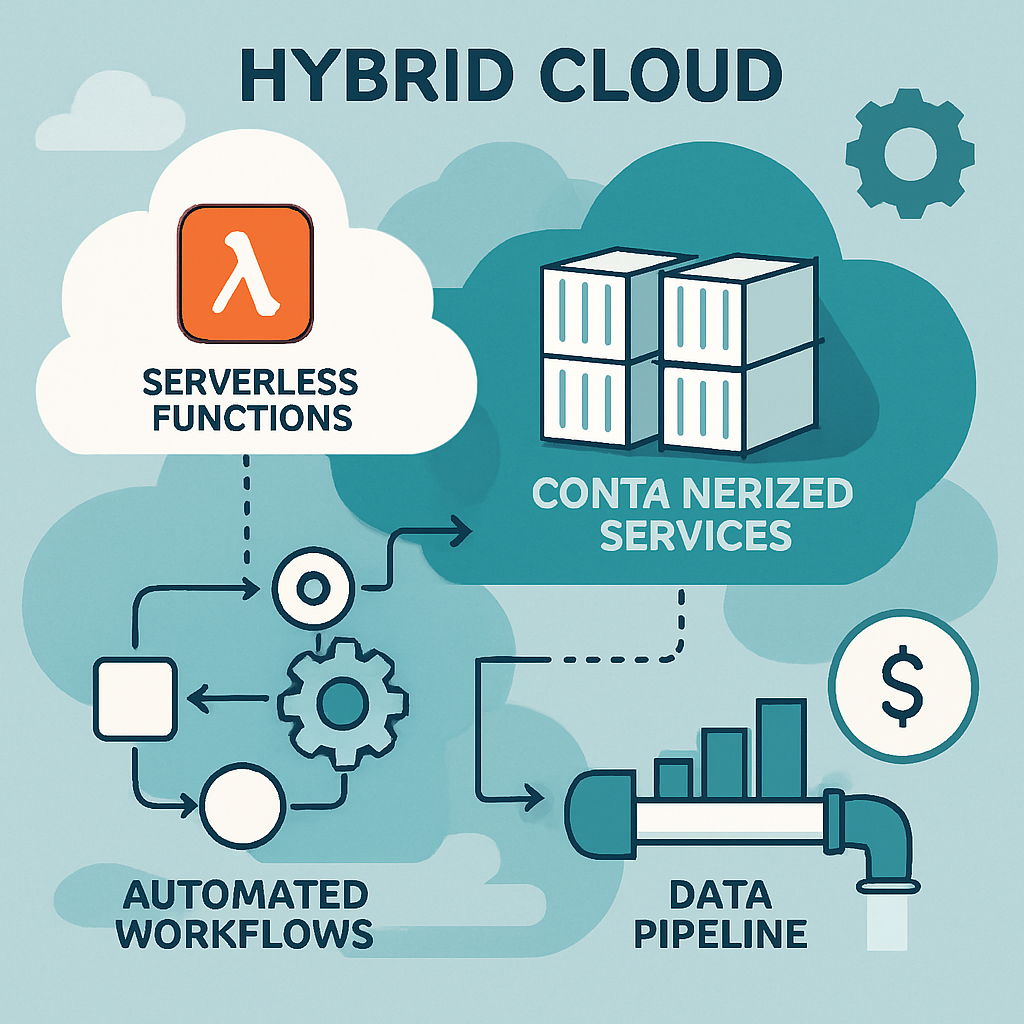
The best cloud architectures rarely pick a single compute model. In practice, the fastest, most resilient teams mix serverless functions with containers to match each job to the right tool. Done well, a hybrid approach reduces cost, speeds delivery, and scales smoothly from zero to millions of requests.
This guide explains when to combine serverless with containers, common patterns, the trade-offs to consider, and how to implement a durable, observable, and cost-aware hybrid stack.
Table of Contents
- What Hybrid Means in Cloud Architecture
- Strengths and Limits of Serverless
- Strengths and Limits of Containers
- When to Mix Serverless with Containers
- Common Hybrid Patterns
- Reference Architectures (AWS, Azure, GCP)
- Design Considerations and Trade-offs
- Implementation Checklist
- Costing and FinOps
- Pitfalls to Avoid
- Tooling and Platform Choices
- Measuring Success
- Conclusion
- Frequently Asked Questions
What Hybrid Means in Cloud Architecture
Hybrid, in this context, blends two compute models: serverless functions (event-driven, scale-to-zero) and containers (service-oriented, long-running). You choose the model per workload, not per company.
A well-architected hybrid stack treats every service as a product with clear contracts. Some services run in containers for predictable performance or special runtimes; others run as functions for elastic, on-demand bursts. The goal is not purity, but fitness for purpose.
Strengths and Limits of Serverless
Strengths
- Automatic scaling and scale-to-zero for sporadic workloads.
- Pay-per-invocation pricing aligns with bursty demand.
- Fast provisioning and simplified operations (no servers to patch).
- Built-in integrations with events, queues, and API gateways.
Limits
- Execution time, memory, and networking constraints.
- Potential cold starts and variable latency.
- Challenging for stateful or long-running tasks.
- Fewer customization options for system libraries or GPU/accelerators.
Strengths and Limits of Containers
Strengths
- Full control over runtime, libraries, and system dependencies.
- Great for steady traffic, long-running jobs, and stateful systems.
- Supports specialized needs like GPUs, custom networking, and sidecars.
- Predictable performance with right-sizing and autoscaling.
Limits
- Operational overhead (cluster management, patching, capacity planning).
- Lower cost-efficiency for spiky, low-volume endpoints.
- Can be slower to spin up compared to functions for sudden spikes.
When to Mix Serverless with Containers
Use serverless where elasticity, event-driven integration, and low ops overhead matter most. Use containers for persistent services, complex runtimes, or heavy compute. Mix them when a single application includes both bursty, evented pieces and steady, service-like components.
- Front doors (APIs, webhooks) benefit from serverless scale and cost control.
- Backends for compute-heavy work or specialized runtimes run well in containers.
- Async glue (queues, events, streams) bridges the two cleanly.
If your system experiences highly variable traffic, if some paths are latency-sensitive while others are not, or if portability and runtime control are required for certain modules, a hybrid is likely the best fit.
Common Hybrid Patterns
1) API gateway + serverless edge, containerized core
Route external requests through an API gateway to serverless functions for validation, authentication, and lightweight transformations. Delegate complex business logic to containerized microservices behind a private network.
- Pros: quick iteration on request shaping; elastic outer layer; protect cores.
- Cons: watch for chatty, synchronous calls increasing tail latency.
2) Event-driven fan-out with containers as workers
Use events or queues to trigger serverless functions that validate, enrich, and enqueue tasks. Containerized workers pull from queues for CPU/GPU-heavy work (e.g., image processing, ML inference batches).
- Pros: decouples spikes; fine-grained scaling of workers.
- Cons: requires robust idempotency and retry controls.
3) Data and ML pipelines
Functions handle lightweight ETL steps or orchestrate tasks. Containers run heavier stages (feature generation, model training) with custom libraries and accelerators.
- Pros: right-size compute per stage; simpler packaging for heavy stacks.
- Cons: need consistent schema/versioning across function and container steps.
4) Scheduled tasks and batch
Use serverless for cron-like triggers and coordination. Fan out jobs to containers for long-running or memory-intensive work, then publish completion events.
- Pros: avoids idle container capacity for occasional jobs.
- Cons: ensure timeouts and heartbeats for visibility.
5) Edge acceleration with serverless, regional services in containers
Run request rewrites, caching, and lightweight personalization at the edge using functions. Keep regional APIs, data services, or streaming processors in containers.
- Pros: lower latency globally; keep complexity in a few regions.
- Cons: duplication risk if edge and core logic diverge.
Reference Architectures (AWS, Azure, GCP)
While the principles are cloud-agnostic, these reference stacks illustrate how pieces fit together.
- AWS: API Gateway or ALB to Lambda for request mediation; SQS/SNS or EventBridge for async; EKS services for stateful or heavy compute; Step Functions for orchestration.
- Azure: Front Door or API Management to Azure Functions; Event Grid or Service Bus; AKS for services needing custom runtimes; Durable Functions for workflows.
- GCP: API Gateway or Cloud Endpoints to Cloud Functions; Pub/Sub for events; Cloud Run or GKE for containerized services; Workflows for orchestration.
The exact products matter less than consistent contracts and a clear split between evented, bursty edges and steady, service-like cores.
Design Considerations and Trade-offs
Latency and cold starts
- Keep latency-sensitive paths in warm containers or provisioned concurrency for functions.
- Pre-compute or cache tokens, templates, or lookups to minimize work per invocation.
Workload profile
- Bursty, unpredictable traffic: serverless first.
- Long-running or heavy compute: containers first.
- Mixed: edge/serverless for I/O-bound, containers for CPU/GPU-bound.
State and data gravity
- Place compute near data to avoid transfer costs and latency.
- Use queues or events to avoid synchronous cross-boundary calls when data must move.
Networking and connectivity
- Plan VPC/VNet integration for functions reaching private services.
- Minimize cross-zone/region chatter unless you need multi-region failover.
Security and identity
- Use least-privilege identities for functions and services; rotate secrets automatically.
- Prefer short-lived credentials; consider mTLS for service-to-service traffic.
Reliability and backpressure
- Queue between layers to absorb spikes; set DLQs for poison messages.
- Configure autoscaling with sensible max concurrency to protect downstreams.
Observability
- Consistent correlation IDs across functions and containers.
- Structured logs; percent-based sampling for traces; RED/USE metrics.
Developer experience
- Local mocks for events/queues; containerized dev environments for parity.
- Clear ownership and runbooks per service/function.
Implementation Checklist
- Define boundaries: list services best as functions vs. containers based on workload, latency, and runtime needs.
- Contract first: document APIs and event schemas (versioned, with backward compatibility and schema validation).
- Choose async by default: favor events/queues over sync calls across boundaries.
- Idempotency: implement deduplication keys, safe retries, and DLQs.
- Provisioning: infra as code (e.g., Terraform, Bicep, CDK/Pulumi) for both functions and clusters.
- Security: least-privilege IAM, secret stores, network segmentation.
- Observability: standard logging format, tracing headers, metrics (p95 latency, error rate, saturation).
- Autoscaling: configure function concurrency limits; HPA/KEDA for containers.
- Testing: contract tests, load tests for burst scenarios, chaos drills for dependency failures.
- Release: blue/green or canary for both functions and container services.
Costing and FinOps
Hybrid can optimize spend if you match workload to pricing model. Model total cost per user journey, not just per component.
- Serverless: tune memory/time; use provisioned concurrency sparingly; cache to shorten invocations.
- Containers: right-size requests/limits; bin-pack pods efficiently; scale to zero on dev/test; consider spot/preemptible for workers.
- Data transfer: place compute and data together; beware cross-region egress.
- FinOps hygiene: budgets, alerts, and unit economics (cost per 1000 requests, per order, etc.).
Pitfalls to Avoid
- Distributed monolith: too many sync calls between small units increase coupling and latency.
- Overusing functions for heavy, long-running jobs: move these to containers or batch services.
- Ignoring limits and quotas: concurrency caps, connection pools, and queue throughput matter.
- Observability gaps: without tracing and IDs, debugging cross-model flows is painful.
- Security sprawl: inconsistent IAM roles or secrets management across platforms.
Tooling and Platform Choices
Pick tools that lower cognitive load and standardize workflows across both models.
- API management: gateways for routing, auth, throttling, and observability.
- Event backbone: event bus and queues with schema registry and replay support.
- Container platform: managed Kubernetes or serverless containers with autoscaling (HPA, KEDA).
- CI/CD: pipelines that package functions and containers with policy-as-code and automated tests.
- Runtime standards: a single logging/tracing library and error model for all services.
Measuring Success
Define clear outcomes before building. Track both user-facing and internal signals.
- SLIs/SLOs: availability, latency percentiles, error budgets.
- Operational: change lead time, deployment frequency, MTTR, incident rate.
- Economics: cost per transaction, per active user, per GB processed.
- Scalability: time to handle 10x burst; autoscaling stability (no oscillation).
Conclusion
Mixing serverless with containers is not a compromise; it is a strategy to align compute with workload characteristics. Use serverless where elasticity and low ops win, and containers where control, performance, or specialized runtimes matter.
Start small: split your system along natural seams, adopt async boundaries, and invest early in observability and security. With disciplined contracts and a clear operating model, a hybrid architecture delivers speed, resilience, and cost efficiency.
Frequently Asked Questions
Does a hybrid approach increase complexity?
It can, if boundaries are fuzzy. Keep contracts explicit, prefer async integration, and standardize tooling. Good discipline reduces complexity while preserving flexibility.
How do I decide serverless vs. container for a new service?
Ask: Is traffic spiky? Is latency tolerance moderate? Are runtime needs simple? If yes, start serverless. If it is long-running, needs custom runtimes or GPUs, or is latency-critical, choose containers.
Can I run serverless-like workloads on Kubernetes?
Yes. Platforms that scale containers to zero and react to events can provide a serverless experience. You still manage more infrastructure than with fully managed functions.
What about security across both models?
Apply least-privilege IAM to functions and services, centralize secrets, and use network segmentation. Consistent logging, tracing, and policy-as-code help spot and prevent misconfigurations.
Leave a Reply