
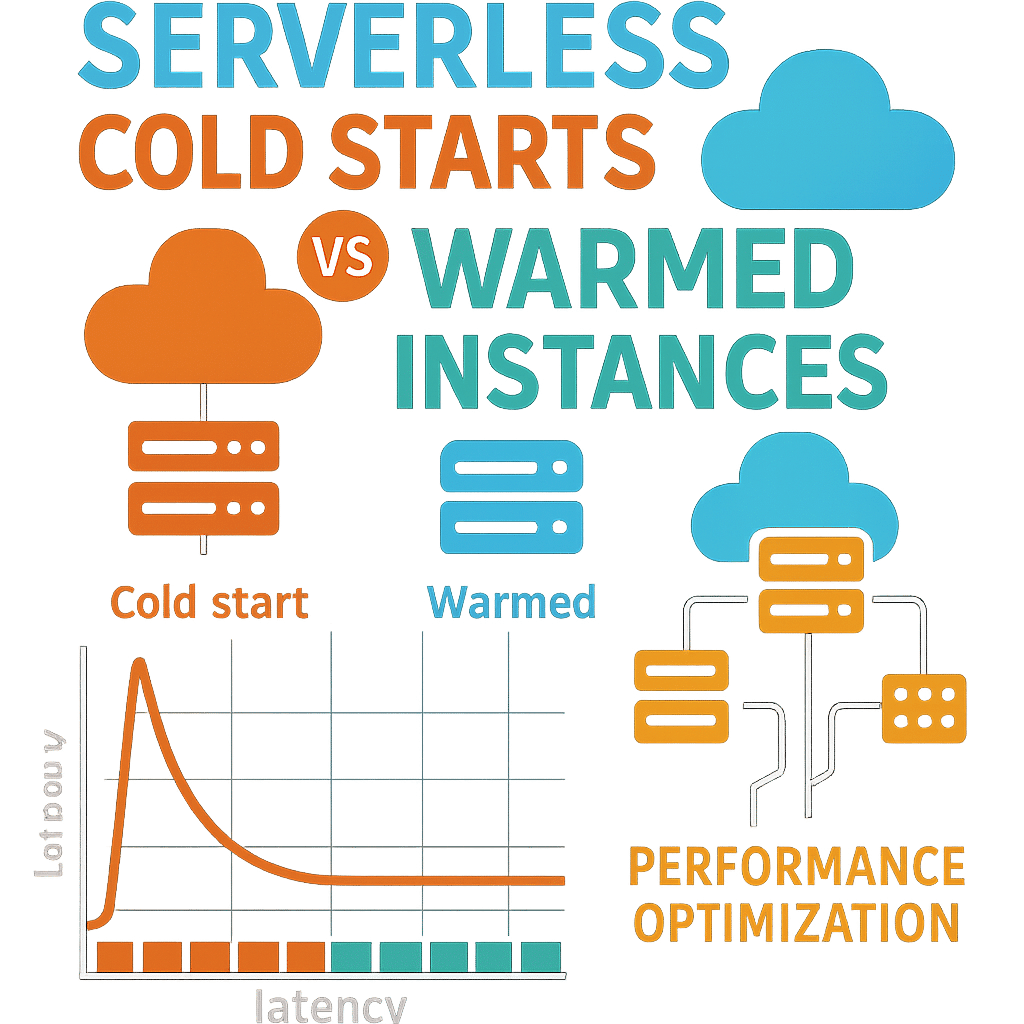
Nothing tests a serverless app like a sudden spike of real users. If the first request takes seconds instead of milliseconds, you feel the sting of a cold start. The good news: cold starts are predictable, measurable, and tameable with the right blend of techniques such as warmers, provisioned concurrency, and platform features like SnapStart or minimum instances. This guide distills the options, trade-offs, and practical steps so you can choose confidently.
Whether you are shipping a new API, migrating a monolith, or optimizing an event-driven pipeline, you will learn when to pay for always-warm capacity, when to lean on smart design patterns, and when a few code tweaks will do.
Table of Contents
- What Are Cold Starts?
- Why Cold Starts Happen in Serverless
- Measuring the Impact and Setting SLOs
- Warmers: Ping Your Functions to Stay Warm
- Provisioned Concurrency: Paying for Predictability
- SnapStart, Min Instances, and Other Platform Options
- Code and Runtime Optimizations
- Architecture and Queueing Patterns
- Networking, VPC, and Connections
- Cost, Trade-offs, and When to Use What
- A Simple Decision Framework
- Implementation Checklists by Cloud
- Monitoring, Alarms, and Testing
- Common Myths and Realities
- Conclusion
What Are Cold Starts?
A cold start is the extra latency you see when a serverless platform creates a new runtime instance to handle a request or event. That instance needs to be provisioned, your code package must be downloaded and initialized, and any connections or libraries are set up before the handler runs. After this first-time cost, subsequent requests on the same instance are typically faster, called warm invocations.
Cold starts matter most for latency-sensitive interactions like APIs, synchronous webhooks, or chat interfaces. For asynchronous jobs or batch processing, a cold start is usually acceptable, as long as it does not violate an end-to-end service level objective.
Why Cold Starts Happen in Serverless
Serverless platforms optimize for scale-to-zero and elasticity. When there are no requests, there is no running compute. When traffic arrives, the platform scales up by creating instances. The lifecycle commonly includes:
- Provision phase: create the sandbox or container
- Init phase: download code, load environment variables, initialize runtime and libraries
- Invoke phase: execute your handler
The duration of the provision and init phases varies by runtime and codebase size. Lightweight languages like Node.js and Python tend to initialize quickly. Heavier runtimes like Java and .NET often pay more up front, especially with large dependency trees, reflection, dynamic proxies, or JIT startup costs.
Measuring the Impact and Setting SLOs
Before optimizing, quantify how much cold starts affect users and business outcomes. Define a latency SLO that reflects the real need, like p95 API latency under 250 ms during peak hours.
Key metrics to capture
- Cold start rate: percent of invocations that were cold
- Init duration: platform reported time to initialize code
- p50, p95, p99 end-to-end latency by route or event type
- Error rate and timeouts, especially on backends like databases
- Traffic shape: concurrency peaks, burst size, and idle gaps
Use your platform metrics and logs. For example, AWS Lambda reports Init Duration in logs; CloudWatch and X-Ray can help separate init from handler time. Track warm vs cold latencies separately to prevent averages hiding tail pain.
Warmers: Ping Your Functions to Stay Warm
Warmers are scheduled or on-demand pings that keep one or more instances of a function active, reducing the chance of a cold start. The idea is simple: invoke a function periodically so instances are not reclaimed.
How warmers work
- Schedule invocations on a timer (for example, AWS EventBridge rules every 5 minutes)
- Optionally fan out concurrent pings to keep multiple instances warm for higher expected concurrency
- Return quickly with a lightweight code path to minimize cost
Pros
- Easy to add and tune for modest traffic levels
- Low cost when only 1 to 2 instances must be warm
- No platform-specific billing feature required
Cons and caveats
- No guarantees: platforms may still recycle instances anytime
- Does not protect against cold starts when burst concurrency exceeds warmed instances
- Wastes invocations on keepalives and can create noise in logs and metrics
- Can mask underlying code or dependency issues that inflate init time
Implementation tips
- Make the warmer call path minimal and idempotent
- Warm only the latency-critical functions
- Measure reduction in p95 latency to verify value
Provisioned Concurrency: Paying for Predictability
Provisioned concurrency pre-initializes a set number of instances so requests can land on already-warmed runtimes. You pay to keep these instances ready, whether or not they receive traffic. This trades a predictable baseline latency for a steady cost.
When to use it
- User-facing APIs with strict p95 or p99 targets
- Predictable traffic windows, like business hours or scheduled launches
- Slow-to-initialize runtimes or heavy libraries you must keep
Strengths
- Consistent low-latency response for provisioned capacity
- Integrates with autoscaling to a limit and can be scheduled for cost control
- Works with most languages and deployment methods
Trade-offs
- Steady cost per provisioned instance, even when idle
- Cold starts can still occur above the provisioned concurrency level
- Requires continuous capacity planning and tuning
As a guiding principle, provision just enough to cover your steady-state p95 concurrency and let burst traffic accept occasional cold starts unless business impact justifies more.
SnapStart, Min Instances, and Other Platform Options
Cloud providers offer specialized features to reduce cold start time by snapshotting or maintaining a small pool of warm instances.
AWS examples
- Lambda SnapStart for Java: initializes your function once, snapshots the memory and execution environment at the end of init, then restores it quickly for new instances. Greatly reduces init time for many Java functions. Review compatibility notes and how to handle things like unique IDs, caches, or connections during restore. See AWS docs for current runtime support.
- Provisioned Concurrency: covered above and widely used for latency-sensitive APIs
- Lambda function URLs or API Gateway with caching to reduce direct hits on cold paths where applicable
Google Cloud and Azure
- Cloud Run and Cloud Functions min instances: keep a configured number of instances always warm. Ideal for HTTP APIs and event processing that cannot tolerate startup spikes.
- Azure Functions Premium plan: provides always-ready instances and VNET support, reducing cold start impact for enterprise apps.
Edge and lightweight runtimes
- Cloudflare Workers, Vercel Edge Functions, and other isolates-based platforms often have near-zero cold start, especially for small bundles, which can be ideal for ultra-low-latency edges.
These options push baseline latency down without changing your code much, but they do add ongoing cost responsibilities.
Code and Runtime Optimizations
Often the largest wins come from a few focused code changes that shrink init time without paying for always-warm capacity.
For all runtimes
- Keep packages small: remove unused dependencies, tree-shake, and minify when possible
- Lazy-load heavy modules inside the handler on first use rather than during global init, measuring the trade-off carefully
- Reuse objects across invocations: create SDK clients, DB pools, and configuration at module scope so they persist on warm instances
- Reduce synchronous I O and avoid blocking calls at init time
- Prefer faster JSON and YAML parsers if large configs are loaded
Language choices
- Node.js, Python, and Go typically have faster cold starts than heavier VMs
- For Java, consider SnapStart, trimming dependencies, class data sharing, or native images where feasible
- For .NET, use trimming, ReadyToRun, and avoid reflection-heavy libraries
Container images
- Use smallest possible base image and multi-stage builds
- Bundle only what you need at runtime; defer build tools and tests
- Warm caches during image build when safe (for example, pre-fetch model files)
Always measure before and after. A small code reshuffle can cut cold start by hundreds of milliseconds without any extra spend.
Architecture and Queueing Patterns
Many latency problems attributed to cold start are actually design mismatches. A few patterns can absorb spikes and decouple user experience from startup costs.
- Async fronting: put synchronous traffic behind a lightweight acceptor that enqueues to a queue or bus, then return quickly while work completes in the background
- Queue buffers: SQS, Pub Sub, or Service Bus absorb bursts so downstream workers can scale calmly
- Precompute and cache: generate results or partials ahead of time and serve from CDN or in-memory caches
- Edge routing: move auth, input validation, and simple responses to the edge to avoid triggering cold functions
- Split critical path: keep the user-facing handler minimal and offload heavy tasks to downstream async workers
Networking, VPC, and Connections
Network setup can add noticeable latency to cold and warm invocations alike. Tighten this area to avoid hidden slowdowns.
- Only attach private networking when needed; it can add time during cold initialization
- Use managed connection pools or proxies: for example, RDS Proxy, Cloud SQL Auth Proxy, or connection multiplexers to prevent storms during scale out
- Enable HTTP keep-alive and connection reuse in SDKs
- Cache DNS lookups appropriately and avoid per-invocation re-resolution of endpoints
The goal is to ensure a new instance does not thrash on connection setup when traffic spikes.
Cost, Trade-offs, and When to Use What
Every solution balances latency, cost, complexity, and portability. Think in terms of levers you can pull:
- Money for time: provisioned or min instances buy lower latency at steady cost
- Code for time: refactors reduce init overhead with one-time effort
- Design for time: queues and edge caches reshape traffic to avoid synchronous spikes
Evaluate the actual business impact of cold starts. If p95 latency hurts conversion or SLA penalties, paying for provisioned capacity can be a bargain. If cold starts are rare and only add a small delay, a lighter touch like warmers or minor code optimizations is usually enough.
A Simple Decision Framework
- Measure today: capture cold start rate, init duration, and tail latency
- Set targets: define p95 p99 SLOs for user-facing and back-end paths
- Fix the cheap wins: trim dependencies, lazy-load, and tighten networking
- Choose a capacity strategy: compute the minimal provisioned or min instances needed to cover steady-state concurrency
- Harden architecture: add queues, caches, or edge handling if synchronous latency still exceeds SLOs under bursts
- Reassess quarterly: re-measure traffic shape and adjust provisioned levels or code as your app evolves
Implementation Checklists by Cloud
AWS
- Measure with CloudWatch logs: check Init Duration and Duration distributions per function version
- Enable provisioned concurrency on key aliases or versions; schedule capacity with Application Auto Scaling for peak hours
- Evaluate SnapStart for Java functions; test restore-time behaviors, randomness, and connection re-establishment
- Use RDS Proxy or DynamoDB SDK connection reuse; enable HTTP keep-alive
- Reduce package size with AWS SDK v3 modules and bundlers
- Consider Lambda@Edge or CloudFront Function for simple edge logic
Google Cloud
- For HTTP workloads, prefer Cloud Run with min instances to stabilize latency
- For Cloud Functions 2nd gen, consider setting min instances on underlying services
- Use Pub Sub to absorb bursts and Cloud Tasks for reliable async queues
- Optimize container images and use smaller base images
Azure
- Use Functions Premium plan or App Service plan for always-ready instances
- Leverage Azure Front Door or CDN to cache static or computed content
- Use Service Bus queues and Durable Functions to decouple long tasks
Edge and other platforms
- Adopt isolates-based runtimes for ultra-low cold start where code fits the constraints
- Keep bundles tiny and avoid heavy native dependencies
Monitoring, Alarms, and Testing
You cannot improve what you do not see. Build observability around cold starts as a first-class concern.
- Emit a cold start flag: set a static boolean that flips true on first invocation of each instance to tag logs and traces
- Distinguish init from handler time in dashboards
- Alert on p95 or p99 breaches by route, not just overall
- Run synthetic checks that include idle gaps to exercise cold paths
- Load test with bursty patterns and measure concurrency headroom
Regularly review spend on provisioned or min instances versus user-facing gains; tune thresholds and schedules accordingly.
Common Myths and Realities
- Myth: Cold starts happen on every request. Reality: they occur when the platform needs a new instance or after idle reclamation.
- Myth: Only Java has a cold start problem. Reality: all runtimes have it, though heavier VMs typically pay more.
- Myth: Warmers eliminate cold starts. Reality: they only reduce the chance at low concurrency and do not guarantee warm capacity.
- Myth: Provisioned concurrency is always expensive. Reality: it can be cheaper than lost revenue or missed SLAs when used precisely.
Conclusion
There is no single fix for cold starts, but there is a reliable playbook. Start by measuring the real impact. Take the easy code and networking wins. If users still feel the pain, layer in provisioned or min instances where they matter most. Consider SnapStart or edge runtimes when they fit. Finally, use queues and caching to reshape traffic and protect the user experience.
Tame cold starts by choosing the smallest, clearest solution that meets your SLOs. Revisit as your traffic and code evolve, and keep observability close at hand.
Frequently Asked Questions
Do I need provisioned concurrency for every function?
No. Reserve it for latency-critical paths with consistent traffic or strict SLOs. Many functions do fine with code optimizations and occasional cold starts.
Are warmers a best practice?
They are a pragmatic tactic, not a guarantee. Use them sparingly to reduce cold starts at low concurrency, and verify that the benefit outweighs cost and noise.
What is the fastest way to cut cold start without spending more?
Trim dependencies, reduce package size, lazy-load heavy modules, and improve networking and connection reuse. Measure after each change.
How do I know how many instances to provision?
Look at your p95 steady-state concurrency during peak windows. Provision just above that, then monitor tail latencies and scale settings to fine-tune.
Leave a Reply