
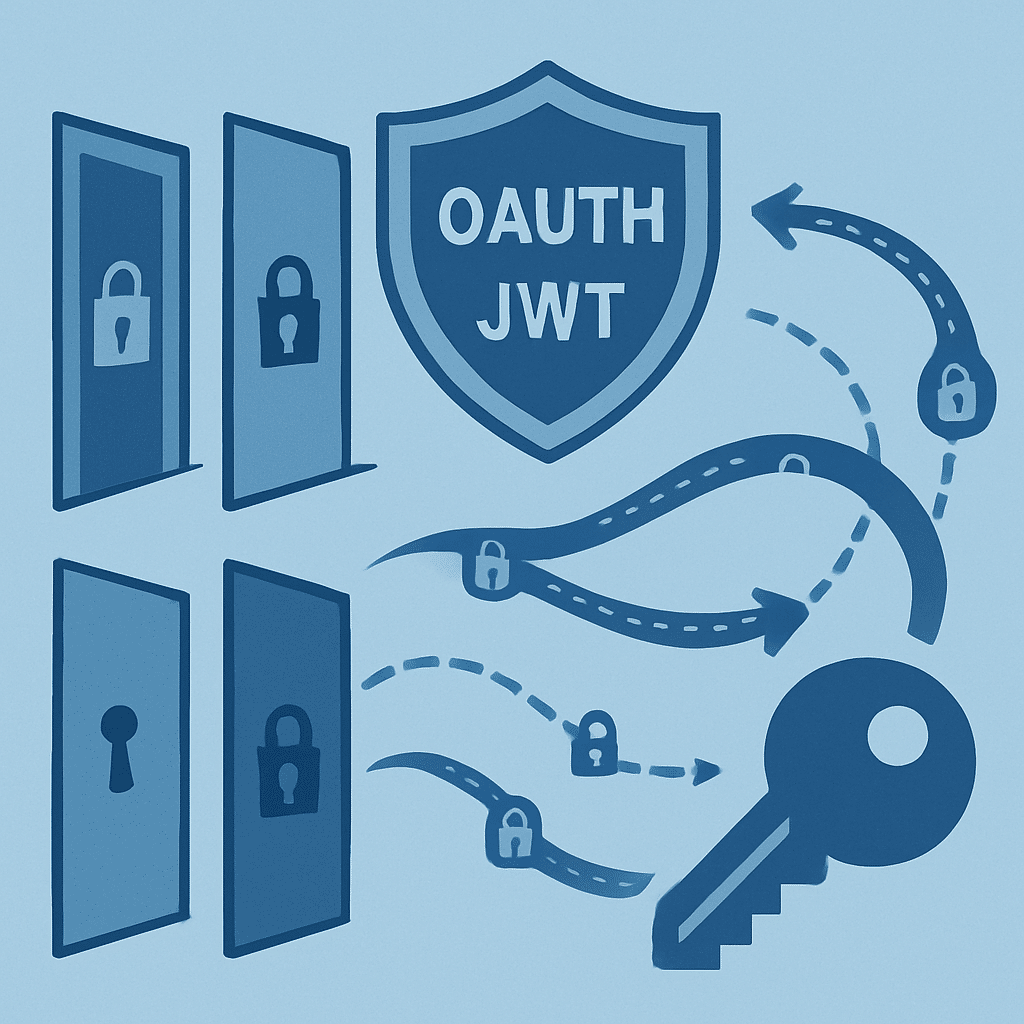
APIs are the nervous system of modern software. They connect mobile apps to data, link partners to platforms, and power internal microservices. But every connection point is a door—and doors need locks. Secure API authentication is how you prove who is calling your API and decide what they can do. In this guide, we demystify OAuth, JWT, and the techniques beyond bearer tokens so you can choose the right approach with confidence.
If you’re building or integrating APIs—whether for a side project or an enterprise platform—this primer will give you clear concepts, practical patterns, and security best practices in a professional, plain‑English style.
Table of Contents
- Why Secure API Authentication Matters
- Key Terms and Building Blocks
- OAuth 2.0 in Practice
- OpenID Connect for User Login
- Understanding JWT
- Beyond Bearer Tokens
- API Keys and When They Fit
- Designing Secure Authorization
- Implementation Best Practices
- Common Pitfalls to Avoid
- Testing, Monitoring, and Ops
- Emerging Trends
- Conclusion
- Frequently Asked Questions
Why Secure API Authentication Matters
Every API call should come from a known, trusted party. Without solid authentication, attackers can impersonate clients, scrape data, or pivot inside your systems. Strong authentication reduces fraud, protects users, and helps you meet compliance requirements.
Security also supports product goals. With the right framework, you can grant granular access (e.g., read-only vs. admin), enable safe third‑party integrations, and deliver smooth login experiences—without exposing sensitive data.
Key Terms and Building Blocks
Identity, Authentication, Authorization
Identity is who a caller is. Authentication (AuthN) proves identity. Authorization (AuthZ) decides what an authenticated identity can access. In APIs, these steps are often separate but coordinated.
Tokens
Tokens are credentials presented to APIs. Common types include opaque tokens (random strings validated server-side) and JWT (self-contained JSON Web Tokens). Tokens can represent users or machines and carry scopes/claims that drive authorization.
Standards You’ll See
- OAuth 2.0: Delegates access via tokens, widely used for API authorization.
- OpenID Connect (OIDC): Identity layer on top of OAuth 2.0 for user login.
- JWT (RFC 7519): A compact, signed token format often used as OAuth access or ID tokens.
OAuth 2.0 in Practice
OAuth 2.0 defines roles (resource owner, client, authorization server, resource server) and flows for obtaining tokens. Its flexibility is powerful—but you must choose the right flow and secure it properly.
Common Flows
- Authorization Code with PKCE (for user-facing apps): The best choice for web, mobile, and single-page apps. PKCE protects against code interception by binding the code to the client’s secret verifier.
- Client Credentials (for server-to-server): A machine identity (client) authenticates to obtain an access token, commonly used for microservice-to-microservice calls.
- Device Code (for TVs/limited input): Lets users approve access on another device.
Scopes, Consent, and Least Privilege
Scopes express what an access token lets a client do (e.g., payments:read). Keep scopes small and task‑oriented. Show clear consent screens for user‑delegated access. Follow the least privilege principle.
Refresh Tokens and Lifetimes
Use short‑lived access tokens (minutes) and rotate refresh tokens. Consider sender‑constrained refresh tokens for higher security. Revoke tokens quickly when risk is detected.
Threats and Mitigations
- Token theft: Use TLS everywhere, avoid storing tokens in insecure locations (e.g., browser localStorage for highly sensitive apps), and prefer HTTP-only secure cookies if applicable.
- Phishing and redirect hijacking: Enforce exact redirect URIs and use PKCE.
- Scope abuse: Design granular scopes; validate on the resource server.
For a deeper dive and best practices, consult the OAuth 2.0 security recommendations from the IETF and community references.
OpenID Connect for User Login
OpenID Connect adds a standard identity layer to OAuth, enabling secure user authentication and profile access. It introduces the ID Token (often a JWT) that asserts the user’s identity.
ID Tokens vs. Access Tokens
- ID Token: For the client; proves the end user’s identity and login context. Do not send it to your resource APIs for authorization decisions.
- Access Token: For calling APIs; conveys permissions (scopes). Your APIs validate it to allow or deny actions.
Claims, Discovery, and Logout
OIDC defines standard claims (e.g., sub, email). Use the provider’s discovery document (/.well-known/openid-configuration) to configure endpoints and keys. Plan for session management and logout to avoid lingering access.
Understanding JWT
JSON Web Tokens are compact, URL‑safe tokens commonly used as access or ID tokens. They enable stateless validation but require careful handling.
Structure and Validation
A JWT has three Base64URL parts: header, payload, signature. Validation includes verifying the signature (e.g., with RS256 or ES256), checking issuer (iss), audience (aud), expiration (exp), not‑before (nbf), and other claims. Fetch public keys via JWKS endpoints published by your auth server.
Algorithm and Key Management
- Disallow alg=none and unexpected algorithms. Pin to specific algorithms your provider uses.
- Rotate signing keys and honor kid key IDs for seamless rollover.
- Prefer asymmetric signatures (RS/ES) for broader validation without sharing private keys.
Expiration, Revocation, and Size
Use short lifetimes. For revocation, prefer short access token TTLs plus refresh token rotation and risk‑based reauthentication. Keep JWTs small—large tokens increase header sizes and can break proxies.
When Not to Use JWT
If you need instant, guaranteed revocation at scale or must store large, dynamic authorization state, consider opaque tokens with server‑side introspection instead of JWTs.
Beyond Bearer Tokens
Bearer tokens are convenient: whoever has the token can use it. But higher‑risk scenarios benefit from sender‑constrained tokens that bind the token to the legitimate client.
Mutual TLS (mTLS)
With mTLS, both client and server present certificates, securing the channel and binding tokens to a client certificate. See RFC 8705 for OAuth mTLS profiles.
DPoP (Demonstration of Proof-of-Possession)
DPoP binds tokens to a public key held by the client, offering sender‑constrained semantics even where full mTLS isn’t practical. Learn more in the IETF OAuth DPoP draft: draft-ietf-oauth-dpop.
Token Types and Hardening
- Use audience‑restricted tokens so a token for Service A can’t be replayed at Service B.
- Prefer one‑token-per-purpose rather than one super‑token spanning multiple backends.
API Keys and When They Fit
API keys are simple identifiers, best for low‑risk, server‑to‑server scenarios, or to track usage and apply rate limits. They are not a user identity and usually lack granular scopes.
- Use API keys for simple service access or analytics—not for high‑value user data.
- Rotate keys, store them securely, and apply IP allowlists or mTLS for sensitive systems.
- If you need per‑user consent or fine‑grained permissions, step up to OAuth.
Designing Secure Authorization
Scopes and Permissions
Start with business actions (e.g., orders:read, orders:refund). Keep scopes orthogonal and explicit. Map scopes to API endpoints consistently.
RBAC, ABAC, and Policy
- RBAC: Roles map to sets of permissions (great for admin panels and teams).
- ABAC: Attribute‑based policies (e.g., user.department == resource.department).
- Externalize authorization logic using a policy engine for complex rules to avoid scattering checks across services.
Multi‑tenant Boundaries
Include tenant identifiers in tokens or enforce them server‑side. Never rely solely on client input to decide tenant access.
Implementation Best Practices
- Enforce TLS 1.2+ end‑to‑end. Terminate TLS only at trusted boundaries.
- Use PKCE for public clients; never ship client secrets to browsers or mobile apps.
- Short‑lived tokens with refresh rotation; detect anomalies and revoke on suspicion.
- Store secrets safely (HSMs or a managed secrets vault). Avoid embedding secrets in code or images.
- Validate every request: signature, issuer, audience, expiration, and scopes. Fail closed.
- Rate limit and throttle to blunt brute‑force and token guessing.
- Log minimally: never log full tokens. Redact sensitive fields.
- Zero trust mindset: authenticate and authorize each hop across services.
Common Pitfalls to Avoid
- Using the implicit flow instead of Authorization Code with PKCE for SPAs.
- Reusing one token for multiple services or tenants.
- Trusting alg or skipping signature verification on JWTs.
- Overbroad scopes like admin:* for convenience.
- Storing bearer tokens in insecure client storage or third‑party logs.
Testing, Monitoring, and Ops
Security Testing
- Unit test token validation paths and claim checks.
- Automate integration tests for OAuth flows, redirect URIs, and PKCE.
- Run dynamic scans and have threat models for key flows.
Observability
- Track authentication success/failure rates, token error codes, and unusual scope usage.
- Emit structured audit logs (actor, action, resource, outcome) while redacting secrets.
Incident Response
Be ready to revoke credentials, rotate keys, invalidate sessions, and push configuration updates quickly. Practice playbooks in tabletop exercises.
Emerging Trends
- OAuth 2.1: A consolidation of best practices (PKCE by default, removal of legacy flows). See the evolving draft on the OAuth site.
- FAPI and high assurance profiles: Stricter requirements for financial-grade APIs.
- Phishing‑resistant auth: WebAuthn/passkeys for strong user authentication feeding into OIDC.
- Fine‑grained authorization: External policy engines and consent-aware scopes.
Conclusion
Secure API authentication isn’t one size fits all. Use OAuth 2.0 for delegated access, OIDC for user identity, and pick JWT or opaque tokens based on operational needs. Strengthen high‑risk integrations with sender‑constrained tokens like mTLS or DPoP. Keep scopes tight, validate diligently, and automate testing and monitoring.
Start by mapping your use cases, selecting flows (Auth Code with PKCE or Client Credentials), and writing a minimal policy for scopes and roles. From there, iterate: shorten token lifetimes, improve observability, and harden storage and transport. The result is safer systems and smoother developer experiences.
Frequently Asked Questions
Should I use JWTs or opaque tokens?
Use JWTs for stateless validation and broad scalability, especially when many services need to verify tokens. Choose opaque tokens with introspection if you need immediate revocation, smaller tokens, or want to centralize authorization state.
Is PKCE required for web and mobile apps?
Yes—treat PKCE as mandatory for public clients, including SPAs and mobile apps. It protects authorization codes from interception even without a client secret.
Are API keys enough for production APIs?
API keys are fine for low‑risk server integrations and usage tracking but lack user identity and fine‑grained permissions. For user data or partner ecosystems, adopt OAuth 2.0.
How long should access tokens live?
Prefer minutes (e.g., 5–15 minutes). Pair with refresh token rotation, anomaly detection, and revocation processes for a balance of security and usability.
Leave a Reply