
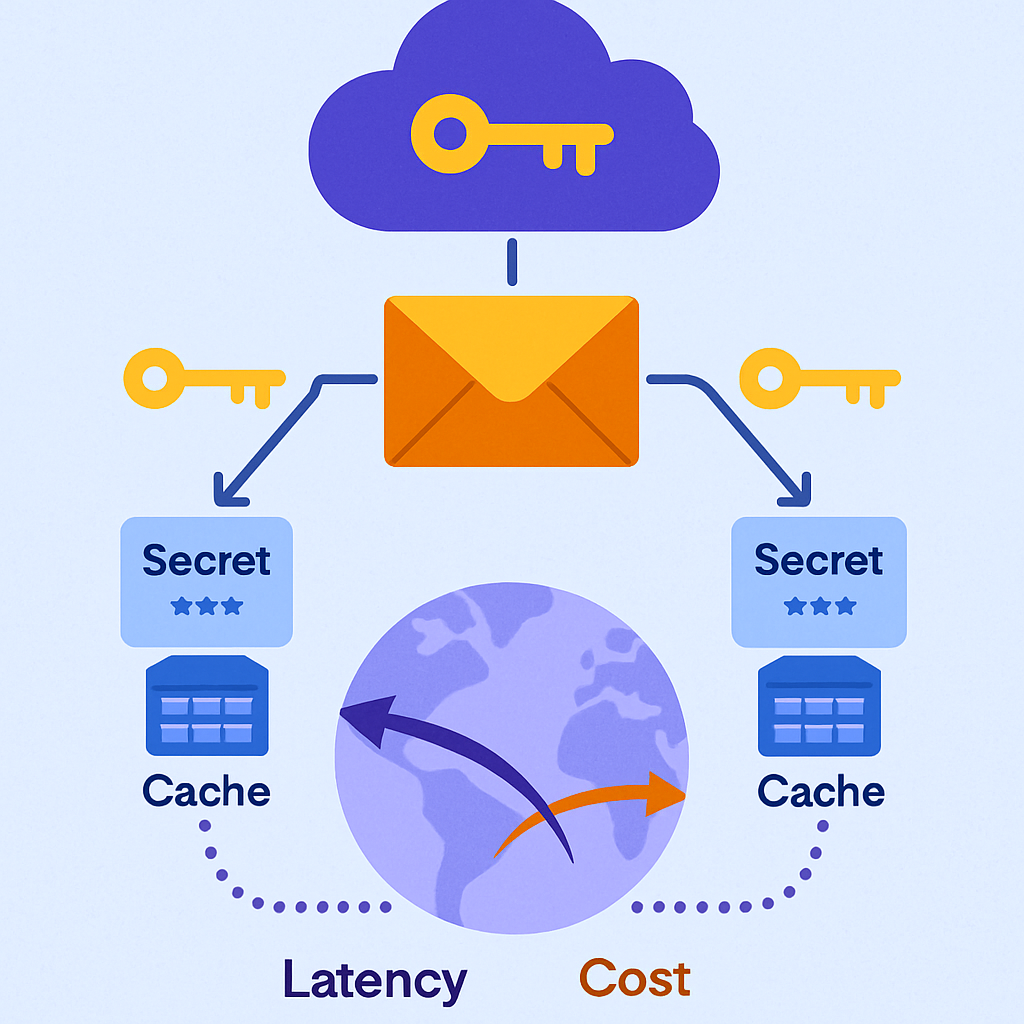
Secrets keep modern applications running: API credentials, database passwords, tokens, and encryption keys all must be protected, rotated, and delivered with low risk. Many teams lean on cloud Key Management Services (KMS) to back their secrets, aiming for strong cryptography, centralized control, and auditability. But how do KMS-backed secrets affect your cost, performance, and SLAs in practice? This guide explains the trade-offs and gives you a clear framework to choose the right design for your workloads.
Whether you are building your first cloud-native app or tuning a globally distributed platform, understanding the economics and latency profile of KMS-backed patterns will help you prevent outages, cut spend, and satisfy compliance without slowing engineers down.
Below, we break down the cost model, examine latency and throughput considerations, clarify SLAs, and outline proven architecture patterns and operational best practices.
Table of Contents
- Understanding KMS-Backed Secrets
- Cost Model Breakdown
- Performance Considerations
- SLA and Availability
- Security and Compliance Trade-offs
- Architecture Patterns
- Operational Best Practices
- Cost and Latency Optimization Checklist
- Decision Framework and Examples
- Monitoring and Troubleshooting
- Conclusion
- Frequently Asked Questions
Understanding KMS-Backed Secrets
Cloud Key Management Services (such as AWS KMS, Azure Key Vault, and Google Cloud KMS) provide centralized management of cryptographic keys, access control, audit logs, and hardware-backed protections. When we say a secret is “KMS-backed,” we typically mean the secret’s value is encrypted under a KMS-managed key or managed by a secrets service that relies on KMS under the hood.
Envelope encryption in a nutshell
Envelope encryption uses a master key in KMS to encrypt short-lived data keys. Those data keys then encrypt the actual secret payloads. This pattern limits the number of direct KMS calls and provides scalable performance with strong cryptography.
Direct KMS vs. managed secrets stores
You can integrate directly with KMS (encrypt/decrypt API) or use a managed secret store (e.g., Secrets Manager-type services) that also rely on KMS for key protection. Managed stores add features such as versioning, rotation workflows, and fine-grained IAM, while direct KMS calls provide flexibility and potentially lower request volume with careful caching.
Cost Model Breakdown
Costs vary by provider and change over time, but the typical drivers are consistent. Understanding where spend comes from helps you design for predictable bills and avoid surprise spikes.
Primary cost drivers
- API request volume: Each Encrypt, Decrypt, GenerateDataKey, or GetSecret call is billable. High-frequency, per-request decrypts add up quickly.
- Key lifecycle: Charges may apply for key creation, storage, rotation, and usage. Customer-managed keys (CMKs) often have different pricing from provider-managed keys.
- Managed secret storage: Secrets services can charge per secret, per version, and per API request. Rapid versioning and frequent reads are common cost multipliers.
- Cross-region or cross-account access: Some architectures incur additional overhead for network or inter-account patterns.
Design choices that influence cost
- Cache hit rate: A high hit rate on decrypted secrets (process, sidecar, or node-local) dramatically reduces paid API calls.
- Batching and startup warm-up: Preloading secrets at startup limits mid-flight decryption calls and helps cap request spikes.
- Rotation cadence: Frequent rotation increases version count and read activity. Set rotation periods based on risk rather than arbitrary intervals.
- Key hierarchy depth: More keys and granular isolation may raise costs but improve blast-radius control and compliance alignment.
Cost forecasting tips
- Estimate requests per second, per service, and multiply by secrets used per request. Model cache TTL and expected hit rate.
- Account for autoscaling: During surges, cold instances often miss the cache, spiking KMS calls.
- Separate steady-state read cost (app runtime) from operational costs (rotations, deployments, migrations).
Performance Considerations
Every round trip to a KMS or a secrets store adds latency and can become a bottleneck under load. Designing for low-latency delivery of secrets is essential for p95–p99 reliability.
Where latency comes from
- Network hop: Calling KMS over the network introduces additional milliseconds per request, sensitive to distance and congestion.
- Cold starts: Fresh containers/functions that must decrypt on first use can add noticeable startup delay.
- Throttling and retries: Hitting service quotas increases tail latency during bursts.
Reducing secret-related latency
- Cache decrypted values: Use in-process memory with short TTLs; consider a node-local or sidecar cache for multi-process reuse.
- Use envelope encryption: Generate a data key once, then reuse it to decrypt multiple local values, reducing KMS calls.
- Pre-fetch on startup: Load and decrypt required secrets during initialization, then refresh asynchronously before expiry.
- Co-locate services: Run workloads and KMS/secrets services in the same region to minimize network distance.
Throughput planning
- Measure and enforce concurrency limits on secret fetch/decrypt operations.
- Apply exponential backoff with jitter for retries to smooth bursts.
- Distribute traffic across regions only if your app can tolerate multi-region key access complexity.
SLA and Availability
Cloud KMS and managed secret stores publish service-level commitments. Your application’s availability depends on more than those numbers: the architecture pattern and caching strategy matter just as much.
Map service SLAs to app SLOs
- Read-path resilience: If every request depends on a live decrypt, your app inherits KMS availability. Caching decouples app uptime from transient KMS issues.
- Regional design: Many providers offer regional isolation. Multi-region failover requires key replication and IAM alignment.
- RTO/RPO implications: Ensure keys and secret versions are replicated according to your recovery objectives.
What if KMS is degraded?
- Leverage cached secrets until TTL expiry; tighten monitoring to detect stale credentials.
- Use circuit breakers to avoid cascade failures when KMS errors surge.
- Document a break-glass procedure to extend TTLs or switch to known-good credentials in emergencies, with tight auditing.
Security and Compliance Trade-offs
KMS-backed secrets generally raise the security bar, but implementation choices create trade-offs among confidentiality, integrity, availability, and auditability.
Key protections and audit
- HSM-backed keys: Many KMS offerings use hardware security modules, providing strong key protection and compliance evidence.
- Granular IAM: Limit which principals may use which keys and which secrets, and require separation of duties.
- Comprehensive logging: Capture key usage and secret access logs; send to a centralized SIEM for alerting and audits.
Caching vs. freshness
Caching improves performance and resilience but increases the window in which a compromised secret remains valid. Balance with short TTLs and rapid invalidation on rotation or suspected compromise.
Rotation policy
- Set rotation frequency based on risk and regulatory requirements.
- Coordinate application refresh logic to avoid mid-transaction failures during rotation.
- Automate testing of rotation pipelines in lower environments before production rollouts.
Architecture Patterns
Choose the pattern that fits your traffic profile, operational maturity, compliance needs, and budget. Most teams evolve through these over time.
1) Per-request decrypt via KMS
- How it works: Secret values are stored encrypted; each request triggers a KMS decrypt.
- Pros: Simple mental model; secrets always fresh; narrow caching footprint.
- Cons: Higher cost and latency at scale; inherits KMS availability; risk of throttling under bursts.
2) Envelope encryption with local caching
- How it works: Generate a data key (via KMS) on startup or schedule; decrypt multiple secrets locally; cache decrypted values with short TTLs.
- Pros: Fewer KMS calls; strong performance; graceful degradation if KMS degrades.
- Cons: Requires cache management and careful TTL/refresh logic; slightly staler secrets.
3) Managed secrets store (KMS-backed)
- How it works: Use a provider service for versioning, rotation, access control; it relies on KMS for key protection.
- Pros: Operational simplicity; built-in rotation and audit; consistent APIs.
- Cons: Service-specific costs; possible latency vs. direct KMS + local caching; service quotas to manage.
4) Sidecar/agent cache
- How it works: A local agent handles KMS interactions and exposes secrets via localhost IPC or a shared memory cache.
- Pros: Centralizes logic; language-agnostic; reduces duplicate code.
- Cons: Another component to operate; must harden agent access and inter-process permissions.
Operational Best Practices
Access control and key policy
- Use least-privilege IAM. Separate permissions for key administration vs. key usage.
- Bind applications to specific keys and secrets via resource-level policies, not broad roles.
- Enable explicit deny paths for high-risk actions and use condition keys (e.g., source VPC, tags).
Resilience and retries
- Implement exponential backoff with jitter for all KMS and secrets calls.
- Add circuit breakers to reduce pressure during outages.
- Warm caches on deploys and scale-out events to avoid thundering herds.
Rotation and rollout safety
- Support dual-credentials during rotation (old/new) to avoid downtime.
- Stage rotations by environment; monitor error rates before proceeding.
- Automate rollback on elevated authentication or connection failures.
Governance and auditing
- Centralize logs for key usage and secret access; set alerts for anomalous spikes.
- Tag keys and secrets with owners, environments, and data classifications.
- Review access lists regularly; time-box temporary access grants.
Cost and Latency Optimization Checklist
- Cache decrypted secrets with short, configurable TTLs.
- Batch decrypts at startup; refresh asynchronously.
- Use envelope encryption to amortize KMS calls across many values.
- Right-size rotation intervals to risk; avoid unnecessary churn.
- Place apps and KMS/secrets in the same region; avoid cross-region hops.
- Throttle and queue secret fetches during scale-out.
- Track request counts per service; set budgets and alerts.
- Test under load with realistic cold-start patterns.
Decision Framework and Examples
Use this quick framework to choose a pattern that meets your security, performance, and cost goals.
Key questions to decide
- Traffic profile: Is your workload request-heavy with strict p99 SLOs, or batchy/interactive with more tolerance?
- Secret volatility: How often do secrets change? Is near-real-time revocation required?
- Operational maturity: Can the team operate a sidecar/cache or do you prefer a managed service?
- Compliance/audit: Do you need granular logs, approvals, and segregation-of-duties?
- Budget constraints: What is the acceptable steady-state and burst cost envelope?
Example 1: Stateless web API with high RPS
Adopt envelope encryption with in-process or sidecar caching. Preload secrets on startup; refresh proactively. This keeps tail latency low and reduces KMS calls.
Example 2: Event-driven batch processing
Decrypt once per batch window; reuse decrypted values during the job. Cost stays low and per-record latency is unaffected.
Example 3: Regulated workload with strict audit
Use a managed secret store for versioning and rotation workflows. Keep short cache TTLs and enable detailed logging. Accept slightly higher latency for better governance.
Monitoring and Troubleshooting
Visibility is essential to prevent surprises. Track both security and reliability signals and connect them to action.
Metrics that matter
- KMS/secrets request rate: Calls per second by operation and service.
- Latency percentiles: p50/p95/p99 for decrypt/fetch paths and overall request latency.
- Error and throttle rates: 4xx/5xx from KMS/secrets APIs; retry counts.
- Cache performance: Hit/miss ratio; age of cached entries; refresh failures.
- Rotation health: Success/failure counts; time to converge; dual-credential overlap duration.
Alerting and dashboards
- Alert on sudden increases in miss rates, throttle errors, or decrypt latency p99.
- Set budget alerts tied to request counts and secret versions created.
- Correlate KMS/secrets incidents with application error spikes via shared timelines.
Runbooks
- Document steps to extend cache TTLs temporarily during provider incidents, with approval and audit.
- Include safe rollback for failed rotations and known-good credential restoration.
- Provide rate-limit tuning guidelines and backoff settings.
Conclusion
KMS-backed secrets provide strong cryptography, centralized control, and clean audit trails—critical pillars of modern security. The trade-offs come from request-driven costs, added latency per decrypt, and dependency on external SLAs. The good news: with envelope encryption, smart caching, and sound rotation practices, you can achieve low tail latency and predictable spend while preserving robust security.
Start by modeling your request volume and cache strategy, then choose an architecture pattern that aligns with your SLOs and compliance needs. Build in observability, runbooks, and budget alerts, and you will turn secrets management from a risk into a reliability advantage.
Frequently Asked Questions
Should I decrypt secrets on every request or cache them?
Cache them when possible. Per-request decrypts are simple but expensive and add latency. Use short TTLs, proactive refresh, and strong access controls to balance performance and security.
How often should I rotate secrets if they are KMS-backed?
Rotate based on risk, compliance, and exposure. Many teams set 30–90 day intervals for credentials, with on-demand rotation after incidents. Automate rotation and ensure apps handle dual-credential periods gracefully.
What happens if the KMS or secret store is unavailable?
With caching, your app can continue for a defined window. Implement circuit breakers, extend TTLs under a break-glass policy, and monitor closely. Without caching, your app’s availability may track the provider’s SLA.
Is envelope encryption more secure than storing plaintext in memory?
Envelope encryption limits direct KMS usage and protects at-rest data with strong keys, while caching restricts exposure to memory. Combine both: use envelope encryption for storage and minimal, time-bound in-memory plaintext with strict process isolation.
Leave a Reply