
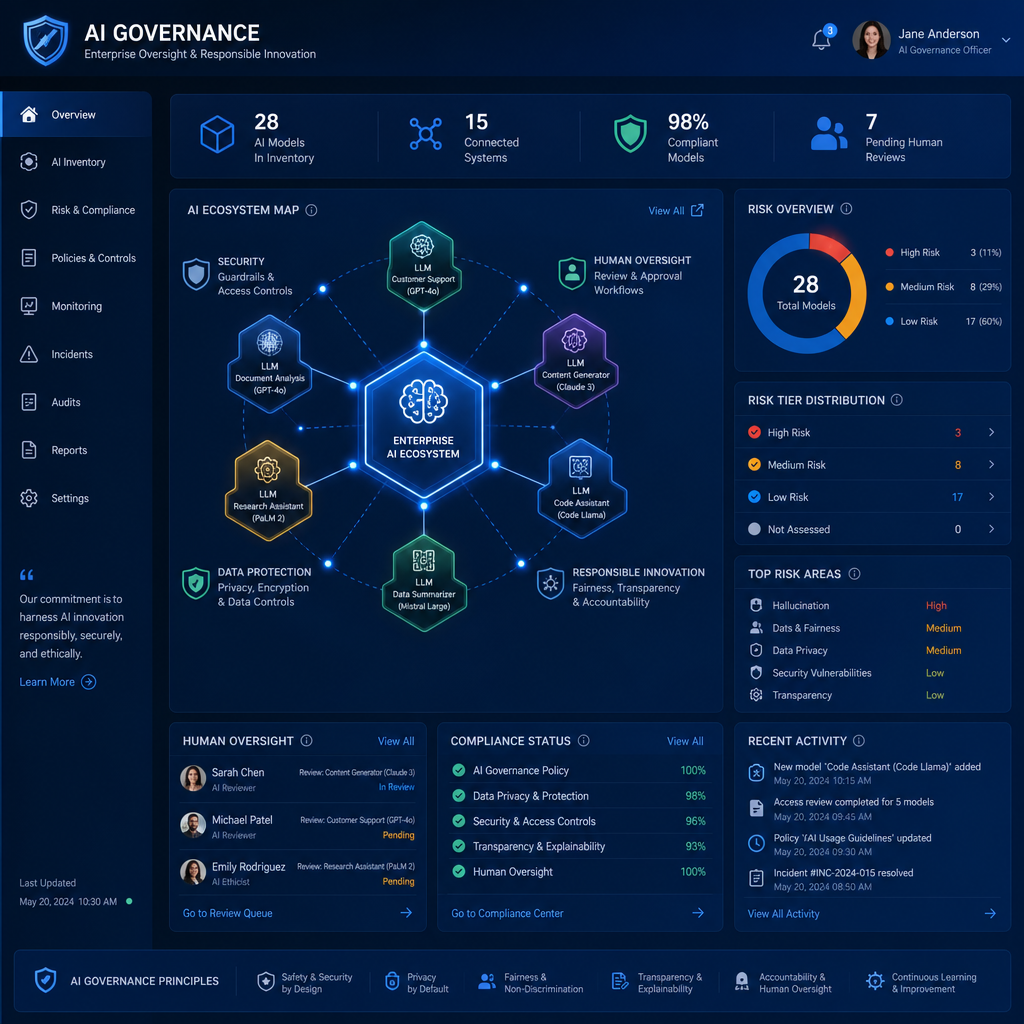
Large language models are moving from experimental chatbots to systems that support customer service, software development, research, marketing, operations, and decision-making. That shift creates significant value, but it also introduces new responsibilities. An enterprise LLM can generate inaccurate advice, expose sensitive information, reinforce bias, or create regulatory and security risks if it is deployed without clear controls.
An effective AI governance framework helps organizations capture the benefits of LLMs while managing those risks deliberately. Governance is not simply a set of approval gates or a compliance checklist. It is an operating model that defines who is accountable, how use cases are evaluated, what technical safeguards are required, and how systems are monitored throughout their lifecycle.
This guide explains how to build a practical framework for enterprise LLM deployments. It covers governance principles, risk classification, ownership, security, data protection, evaluation, monitoring, and the processes needed to scale adoption responsibly.
Table of Contents
- Why AI Governance Matters for Enterprise LLMs
- Define Core Governance Principles
- Classify LLM Use Cases by Risk
- Establish Roles and Accountability
- Build Security and Data Protection Controls
- Test and Evaluate LLM Systems
- Monitor Deployments in Production
- Create an Implementation Roadmap
- Conclusion
- Frequently Asked Questions
Why AI Governance Matters for Enterprise LLMs
Traditional software governance often assumes that a system behaves consistently when it receives the same inputs. LLMs are different. Their outputs can vary, they may rely on incomplete or outdated information, and their behavior can change when models, prompts, retrieval sources, or configurations are updated.
These characteristics make governance essential across the full deployment lifecycle. A framework should address an LLM before launch, during active use, and whenever the system or its operating environment changes.
Without governance, organizations commonly face fragmented experimentation, duplicated vendor reviews, unclear accountability, inconsistent security practices, and unmeasured business impact. A well-designed framework creates a repeatable path from initial idea to approved deployment and ongoing oversight.
Governance is an enabler, not only a restriction
Effective governance should help teams move faster with greater confidence. Clear standards allow product and engineering teams to understand what is permitted, which reviews are required, and what evidence must be collected. The goal is not to eliminate all risk, which is impossible, but to make risk visible, proportionate, and manageable.
Define Core Governance Principles
Before creating policies and review workflows, establish a small set of principles that guide decisions across the enterprise. These principles should be understandable to technical and nontechnical stakeholders.
- Accountability: Every LLM use case has a named business owner and technical owner.
- Transparency: Users understand when they are interacting with AI and how outputs are produced or used.
- Human oversight: People remain responsible for high-impact decisions and can challenge or override system outputs.
- Security and privacy: Data, models, prompts, outputs, and integrations receive appropriate protection.
- Fairness and inclusion: Teams assess whether performance differs across relevant groups or use cases.
- Reliability: Systems are evaluated against defined quality, safety, and performance requirements.
- Proportionality: Controls match the potential impact and likelihood of harm.
These principles should be reflected in procurement standards, architecture reviews, product requirements, employee guidance, and incident response procedures. Publishing principles alone is not enough; organizations must connect them to measurable controls and decision rights.
Classify LLM Use Cases by Risk
Risk classification is one of the most important parts of an AI governance framework. It prevents every use case from receiving the same level of scrutiny and directs resources toward applications with the greatest potential impact.
Consider the major risk dimensions
Assess each proposed deployment across several dimensions rather than relying on a single label. Useful questions include:
- Could an incorrect output cause financial, legal, health, safety, or reputational harm?
- Does the system process personal, confidential, regulated, or proprietary information?
- Does it make recommendations or decisions about individuals?
- Can the model take actions in external systems, such as sending messages or approving transactions?
- How much human review occurs before an output is acted upon?
- How broad is the system’s user base and potential reach?
- How difficult would it be to detect, reverse, or remediate an error?
Create practical risk tiers
A simple three- or four-tier model is often sufficient. Low-risk applications might include internal brainstorming or formatting assistance that does not use sensitive data. Medium-risk applications could support customer communications, business analysis, or code generation with human review. High-risk applications may influence employment, credit, healthcare, legal outcomes, safety decisions, or access to essential services.
Each tier should have defined requirements for testing, legal review, security assessment, human oversight, documentation, and monitoring. The classification should be revisited when the use case, data, model, audience, or level of automation changes.
Establish Roles and Accountability
Governance fails when responsibility is shared so broadly that no one is answerable for an outcome. Create a clear accountability model that spans business, technology, risk, legal, privacy, security, and compliance functions.
Core responsibilities
- Executive sponsor: Sets organizational priorities, approves risk tolerance, and resolves major trade-offs.
- AI governance committee: Establishes standards, reviews higher-risk use cases, and coordinates cross-functional decisions.
- Business owner: Defines the intended outcome, acceptable performance, user population, and operational impact.
- Product or process owner: Maintains requirements, user experience, documentation, and change controls.
- Engineering and data teams: Implement architecture, access controls, evaluations, integrations, and monitoring.
- Security, privacy, legal, and compliance teams: Assess specialized risks and define required safeguards.
- End users: Follow approved procedures, validate outputs, and report problems or policy violations.
A responsibility matrix can clarify who is responsible, accountable, consulted, and informed at each stage. It should cover intake, design, approval, deployment, incident response, model changes, vendor changes, and retirement.
Build Security and Data Protection Controls
Enterprise LLM deployments can expose sensitive information through prompts, retrieval systems, logs, model outputs, plugins, or third-party providers. Security and privacy controls therefore need to cover the entire application architecture, not only the model itself.
Protect data throughout the workflow
- Classify data before it is submitted to a model or connected knowledge source.
- Apply data minimization so systems use only the information required for the task.
- Use encryption in transit and at rest, along with strong identity and access management.
- Separate development, testing, and production data and environments.
- Define retention and deletion rules for prompts, outputs, embeddings, and logs.
- Review whether vendors use enterprise data for training or other purposes.
- Apply redaction, tokenization, or masking where appropriate.
Address LLM-specific threats
Controls should account for prompt injection, data poisoning, insecure plugins, excessive permissions, sensitive information disclosure, model manipulation, and unsafe output handling. Retrieved content should be treated as untrusted input, and model-generated instructions should not automatically receive the authority to execute high-impact actions.
Use least-privilege permissions for tools and integrations. Add approval steps for consequential actions, validate structured outputs, isolate untrusted content, and maintain audit logs that show what the system received, generated, and did.
Test and Evaluate LLM Systems
Generic model benchmarks rarely show whether an LLM application is suitable for a specific enterprise workflow. Evaluation should reflect the system’s intended users, data, tasks, failure modes, and business objectives.
Build an evaluation plan
Start with a representative test set that includes normal requests, edge cases, ambiguous inputs, adversarial prompts, and examples involving different user groups or languages where relevant. Define success criteria before reviewing results. Depending on the use case, these may include factual accuracy, task completion, groundedness, response quality, latency, cost, refusal behavior, and fairness.
Combine automated testing with expert and user review. Automated metrics can identify regressions at scale, while human reviewers are better at assessing usefulness, context, tone, and subtle harms. Document the evaluation method, data sources, limitations, results, and approval decision.
Test changes continuously
Reevaluate the system when the underlying model, prompt, retrieval index, tools, policies, or user population changes. Maintain regression suites so a change that improves one metric does not silently damage safety, accuracy, or performance elsewhere.
Where feasible, use staged rollouts, sandbox environments, and controlled pilots. High-risk systems should have explicit launch criteria and a rollback plan before they reach production.
Monitor Deployments in Production
Approval is not the end of governance. Real-world usage can reveal new failure modes, unexpected user behavior, data drift, prompt attacks, or changes in the business process. Production monitoring turns governance into an ongoing operational capability.
Track indicators such as accuracy, groundedness, refusal rates, user feedback, escalation volume, latency, usage patterns, cost, security alerts, and policy violations. Monitor both technical behavior and business outcomes. A system can be technically available while failing to deliver useful or safe results.
Prepare for incidents
Define what qualifies as an AI incident and establish a response process. Examples include a privacy breach, harmful output, discriminatory behavior, unauthorized action, material misinformation, or a major performance regression.
Incident procedures should identify escalation contacts, containment actions, evidence preservation requirements, notification obligations, root-cause analysis, and corrective actions. Teams should be able to disable a feature, restrict access, revert a model or prompt, and communicate with affected stakeholders quickly.
Maintain an inventory of approved LLM applications and record their owners, models, vendors, data types, risk tiers, evaluation status, and review dates. This inventory is a foundation for auditability and lifecycle management.
Create an Implementation Roadmap
Organizations do not need to build every governance capability at once. A phased roadmap can establish useful controls while allowing the framework to mature with experience.
- Discover: Inventory existing LLM experiments, vendors, applications, data flows, and business owners.
- Set policy: Publish acceptable-use guidance, prohibited practices, risk principles, and minimum security requirements.
- Define intake: Create a standard process for proposing, classifying, reviewing, and approving use cases.
- Standardize controls: Provide approved model access, reusable security patterns, evaluation templates, logging, and documentation tools.
- Pilot governance: Apply the process to representative low-, medium-, and high-risk use cases, then refine it based on feedback.
- Scale oversight: Automate evidence collection, monitoring, inventory updates, and recurring reviews where possible.
- Improve continuously: Use incidents, audit findings, user feedback, and new regulations to update standards and training.
Make compliance practical by giving teams approved pathways rather than only restrictions. A governed platform with secure model access, templates, evaluation utilities, and clear support channels can reduce shadow AI and improve adoption.
Conclusion
Building an AI governance framework for enterprise LLM deployments requires more than selecting a model or writing an acceptable-use policy. Organizations need a connected system of principles, risk tiers, ownership, security controls, evaluations, monitoring, and incident response.
The strongest frameworks are proportionate and operational. They protect sensitive information, preserve human accountability, make system behavior measurable, and give teams a reliable way to move from experimentation to responsible scale. Start with an inventory and a small number of high-value controls, then improve the framework as your organization gains evidence and experience.
Frequently Asked Questions
What is an AI governance framework?
An AI governance framework is a structured set of policies, roles, processes, and technical controls used to manage AI risks and responsibilities across the system lifecycle.
Who should be involved in enterprise LLM governance?
Governance should include business leaders, product and engineering teams, data and security specialists, privacy, legal, compliance, risk management, and representatives of affected users.
How often should an LLM application be reviewed?
Review frequency should match the application’s risk. High-risk systems may require continuous monitoring and scheduled reviews, while lower-risk tools can be reviewed when models, data, integrations, or intended uses change.
Can AI governance slow innovation?
Poorly designed governance can create friction, but clear risk tiers, reusable controls, and approved platforms usually help teams innovate faster by reducing uncertainty and preventing avoidable rework.
Leave a Reply