
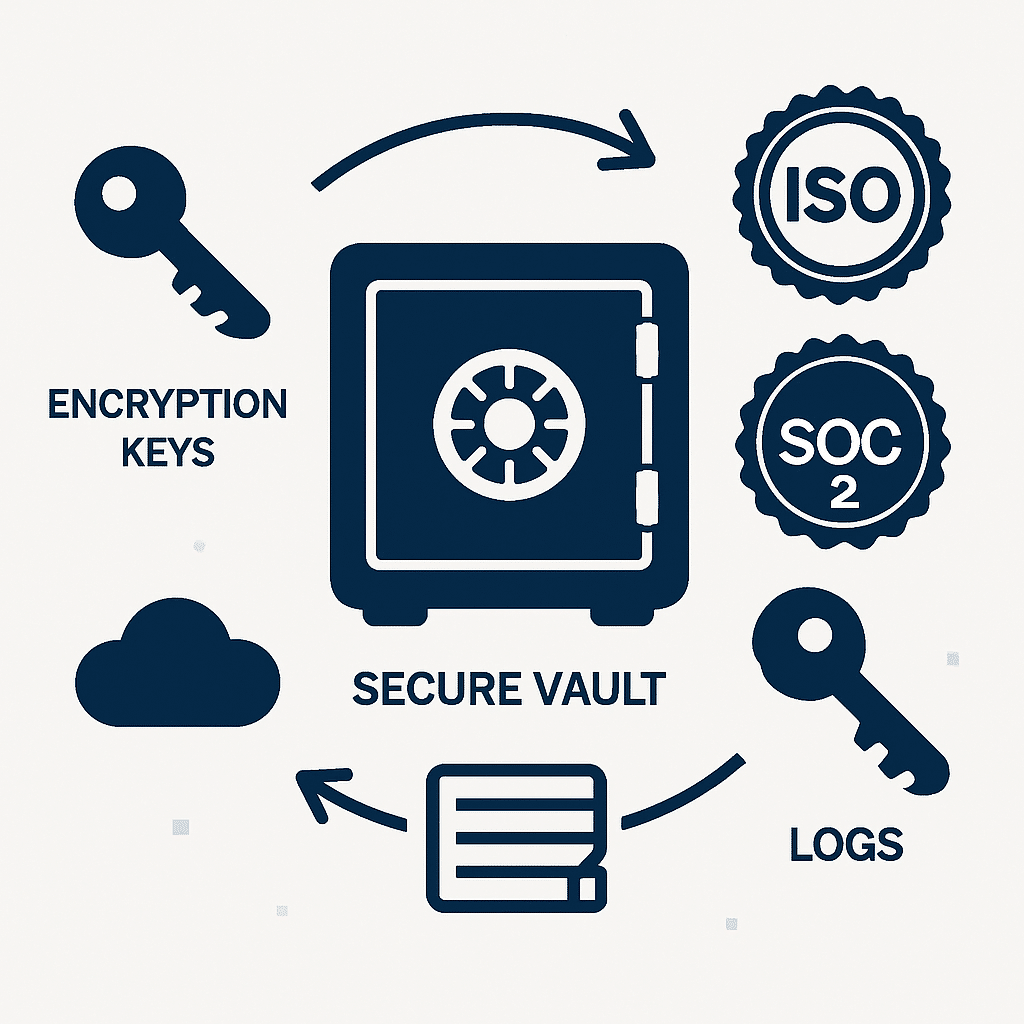
Regulators, customers, and incident responders will not take your word for it. They ask: prove it. Prove that encryption keys are controlled, rotated on time, and that no one misused them. That is the heart of audit-ready key management.
This guide translates compliance expectations into concrete practices you can implement today. We focus on three pillars: logs that capture the right events, rotation policies that reduce risk, and evidence that stands up to scrutiny. Whether you run in the cloud or on premises, the patterns are the same.
By the end, you will have templates, checklists, and practical tips to speed up audits, cut risk, and strengthen trust.
Table of Contents
- Why Audit-Ready Key Management Matters
- Key Terms and Standards
- Designing a Compliance-Grade KMS
- Logging and Evidence Collection
- Rotation Policies That Stand Up to Audits
- Access Control and Separation of Duties
- Proving It to Auditors
- Cloud and Multi Environment Considerations
- Common Pitfalls and How to Avoid
- Practical Implementation Checklist
- Metrics and Continuous Improvement
- Conclusion and Next Steps
- Frequently Asked Questions
Why Audit-Ready Key Management Matters
Encryption is only as strong as the keys that protect your data. If keys are missing, misused, or never rotated, the best algorithms will not help. Breaches, fines, and downtime often trace back to weak key hygiene.
Audit readiness changes the posture from promise to proof. It means you can produce trustworthy evidence at any time, not just scramble before an assessment. You design operations so that logs, approvals, and rotation records are created by default, preserved, and easy to present.
The payoff is real. Strong key management reduces incident blast radius, speeds investigations, and shortens audit cycles. It also demonstrates maturity to customers and partners, strengthening commercial trust.
Key Terms and Standards
First, a few plain language definitions. A cryptographic key is a secret value used to encrypt, decrypt, sign, or verify data. A secret can be a password, API token, or any credential that grants access. A certificate binds a public key to an identity and is issued by a certificate authority.
A key management service, or KMS, creates, stores, and uses keys under policy. A hardware security module, or HSM, is a tamper resistant device that generates and protects keys. Logs record who did what, when, and why. Evidence is the curated set of records you can show to an auditor.
Common compliance frameworks that touch key management
- ISO 27001 and Annex A controls for cryptography, access control, and logging
- SOC 2 criteria for security, change management, and monitoring
- PCI DSS requirements for cryptographic key management and logging
- HIPAA security rule expectations for encryption and audit controls
- FedRAMP control families for key protection, logging, and incident response
- GDPR Article 32 obligations for appropriate security including encryption
The point is not to memorize control numbers. It is to structure your program so a single set of good practices maps cleanly to many frameworks.
Designing a Compliance-Grade KMS
Start with inventory and ownership. You cannot secure what you cannot list. Maintain a registry of all keys, secrets, and certificates with owner, purpose, data classification, algorithm, rotation policy, and expiration.
Centralize lifecycle management. Use a well supported KMS or secrets manager for generation, storage, usage, rotation, and retirement. Where required, select FIPS validated modules and enable envelope encryption so data encryption keys are wrapped by higher level keys.
Build for resilience and control. Apply dual control and M-of-N for high impact operations such as key deletion or export. Back up key material through approved mechanisms, test recovery, and document the process.
Design principles to adopt
- Least privilege access with role based control and service identities
- Immutable, centralized logging and alerting for all key events
- Automated rotation with safe rollover and version tracking
- Change management with approvals tied to tickets and runbooks
- Clear separation of operator, approver, and auditor roles
- Standardized key naming and tagging for discoverability
Logging and Evidence Collection
If it is not logged, it did not happen is the most practical rule for audits. Your goal is comprehensive, tamper evident logs that answer who, what, when, where, and why for every key related action.
Events you should log
- Key lifecycle: creation, import, enable or disable, rotation, rewrap, export, deletion, and scheduled destruction
- Key usage: encrypt, decrypt, sign, verify, wrap, and unwrap operations with requestor identity and client metadata
- Access control: policy updates, grants and revocations, role changes, and permission evaluations
- Administration: configuration changes, network allowlist updates, KMS or HSM firmware changes, and maintenance
- Security signals: failed access attempts, anomaly detections, threshold alerts, and integrity check failures
- Backup and recovery: backup creation, restore attempts, success or failure, and validation results
Retention, integrity, and context
- Retention: keep logs at least through the longest applicable audit window, commonly 12 to 24 months or longer for regulated data
- Integrity: store logs in write once storage, enable object lock where supported, and sign or hash to detect tampering
- Time: synchronize clocks with reliable NTP and record precise timestamps and time zones
- Context: include ticket numbers or change request IDs so auditors can trace intent and approval
Privacy by design
- Never log plaintext secrets or data payloads; log references and hashes where needed
- Redact sensitive request parameters and apply field level controls
- Minimize personal data in logs and adhere to data residency commitments
Centralize log ingestion in a SIEM, apply a consistent schema, and create saved queries that reproduce common evidence packages. This makes audit prep a repeatable task rather than a one off fire drill.
Rotation Policies That Stand Up to Audits
Rotation reduces the value of stolen secrets and limits long term exposure. An audit ready rotation policy is risk based, automated, and well documented, with clear triggers for emergency changes.
Baseline intervals to consider
- Data encryption keys: generate per object or per batch; rotate master wrapping keys every 6 to 12 months
- API keys and tokens: rotate every 60 to 90 days, or shorter for high risk services
- Application passwords and database credentials: rotate every 60 to 90 days with zero downtime techniques
- TLS certificates: use 90 day certificates with automated ACME renewal
- SSH keys: prefer short lived certificates; if static, rotate at least every 90 days
Triggers for out of cycle rotation
- Suspected compromise or anomalous access
- Staff role change or departure
- Vendor or component change that touches key handling
- Algorithm deprecation or policy update
Operational safeguards
- Automate rotation and validation; avoid manual calendar based tasks
- Use overlapping validity and versioned secrets so deployments can roll forward safely
- Test rotation in staging, measure success rate, and document rollback
- Require dual control for rotations of high impact keys such as root or wrapping keys
Crypto agility matters. Keep algorithms and key sizes configurable, and maintain the ability to re encrypt data when standards evolve.
Access Control and Separation of Duties
Strong access control prevents accidental or malicious misuse and is a core audit theme. The principle is simple: only the right identity, on the right system, for the right reason, at the right time.
- Define roles for key users, key administrators, approvers, and auditors; avoid shared admin accounts
- Apply least privilege with resource level scopes and conditional policies
- Enforce MFA for administrative actions and require device posture where supported
- Use just in time access with time bound approvals for sensitive operations
- Record administrative sessions and correlate to change tickets
- Separate environments; do not allow production keys in non production systems
Document a simple separation of duties matrix that shows which roles can request, approve, and execute each key operation. Auditors love this clarity, and it reduces your risk.
Proving It to Auditors
Evidence should be accurate, complete, and easy to verify. Build a repeatable evidence package that pairs policy with proof and highlights exception handling.
What to include in an evidence package
- Key management policy, standards, and runbooks
- Architecture and data flow diagrams showing where keys live and how they protect data
- Key registry export with owners, purposes, and rotation dates
- Saved SIEM queries and log extracts for key creation, rotation, usage, and deletion
- Rotation reports with success rates, exception lists, and remediation timelines
- Access reviews, RBAC mappings, and a separation of duties matrix
- Approvals linked to ticketing systems and change records
- Evidence of module validations where required, such as FIPS certificates
Make validation simple
- Time bound your evidence to the audit period and include hash values or export IDs
- Explain how to reproduce each dataset with a note and a link to the saved query
- Redact secrets and personal data while preserving fields needed to validate controls
- Keep exceptions visible with clear owner and due date; hidden gaps become findings
Pro tip: conduct a lightweight internal audit each quarter. Use the same sampling methods an external auditor would. This reduces surprises and compresses audit timelines.
Cloud and Multi Environment Considerations
Cloud providers offer strong primitives, but you must configure them well and collect the right logs. The good news is that native services integrate cleanly with centralized monitoring.
- AWS: combine KMS with CloudTrail, CloudWatch, and S3 object lock for immutable storage. See AWS KMS overview.
- Azure: enable Key Vault diagnostic settings to ship admin and audit logs to Log Analytics or an external SIEM. See Azure Key Vault docs.
- GCP: use Cloud KMS with Audit Logs and log sinks to BigQuery or Cloud Storage for retention. See GCP Cloud KMS docs.
In hybrid models, align controls across environments. Use policy as code and infrastructure as code so that permissions, logging, and rotation policies are consistent and reviewable. For high assurance needs, consider dedicated HSMs with network isolation.
Finally, map data residency and sovereignty needs. Ensure keys and logs remain in approved regions, and document these constraints in your policy and evidence.
Common Pitfalls and How to Avoid
- Missing inventory: teams forget test keys or legacy certificates. Fix with automated discovery and tagging.
- Manual rotation: calendar reminders fail. Fix with automated rotation and health checks.
- Gaps in logging: no evidence for decrypt operations or policy changes. Fix with end to end log validation.
- Shared admin accounts: no accountability. Fix with named identities, MFA, and least privilege.
- Key sprawl in code repos or CI logs. Fix with secret scanning and redaction at every hop.
- Unvalidated backups: restores fail during incidents. Fix with quarterly recovery tests and documented results.
- Clock drift: timestamps do not line up across systems. Fix with consistent NTP configuration.
Practical Implementation Checklist
- Publish a key management policy and name an accountable owner
- Build a complete key and secret inventory with owners and tags
- Centralize keys and secrets in an approved KMS or vault
- Define rotation targets by type and risk; automate the workflow
- Enable comprehensive logging and ship to a central SIEM with immutability
- Codify RBAC, MFA, and separation of duties; remove shared accounts
- Create saved queries and dashboards for audit evidence
- Test recovery and rotation in staging; record success criteria
- Run a quarterly internal audit against the controls
- Continuously improve with metrics, retrospectives, and training
Metrics and Continuous Improvement
You cannot improve what you do not measure. Track a small set of metrics that reflect coverage, timeliness, and reliability.
- Rotation coverage: percentage of keys and secrets covered by automated rotation
- On time rotation rate: percentage completed before due date
- Mean time to revoke: time from reported compromise to revocation
- Evidence readiness: time to assemble a standard evidence package
- Log integrity: percentage of logs stored with immutability and verified signatures
- Access review completion: quarterly completion rate and findings closed
- Disaster recovery confidence: recovery test pass rate and time to restore
Review metrics monthly, assign owners to gaps, and track improvements in your risk register. Small, steady gains compound into mature, audit ready operations.
Conclusion and Next Steps
Audit ready key management is not about perfection. It is about predictable, well evidenced control over the keys and secrets that protect your data. Focus on comprehensive logs, automated rotation, and curated evidence, and map those practices to the standards you face.
Start by finishing your inventory, turning on complete logging, and automating one high impact rotation. Then iterate. Each cycle will shrink risk and simplify your next audit.
If you need a jump start, adapt the checklist and evidence package ideas above to your context, and schedule a dry run with an internal stakeholder. The best time to prepare proof is before anyone asks for it.
Frequently Asked Questions
Do I need an HSM to be compliant
Not always. Many frameworks allow software based key protection if risk is low and controls are strong. High assurance or regulatory contexts may require FIPS validated HSMs. Choose based on data sensitivity and policy.
How long should I retain key management logs
Keep logs at least through your longest audit window and incident investigation needs, commonly 12 to 24 months. Some regulations or contracts require longer. Document your retention period and storage method.
How often should I rotate keys and secrets
Apply risk based intervals. For example, rotate API keys every 60 to 90 days, certificates every 90 days with automation, and master wrapping keys every 6 to 12 months. Always rotate out of cycle after suspected compromise.
What counts as acceptable evidence for auditors
Evidence should be reproducible system outputs such as log exports, saved SIEM queries, registry reports, and approvals linked to tickets. Pair these with policies, diagrams, and a clear narrative so auditors can verify control operation.
Leave a Reply