
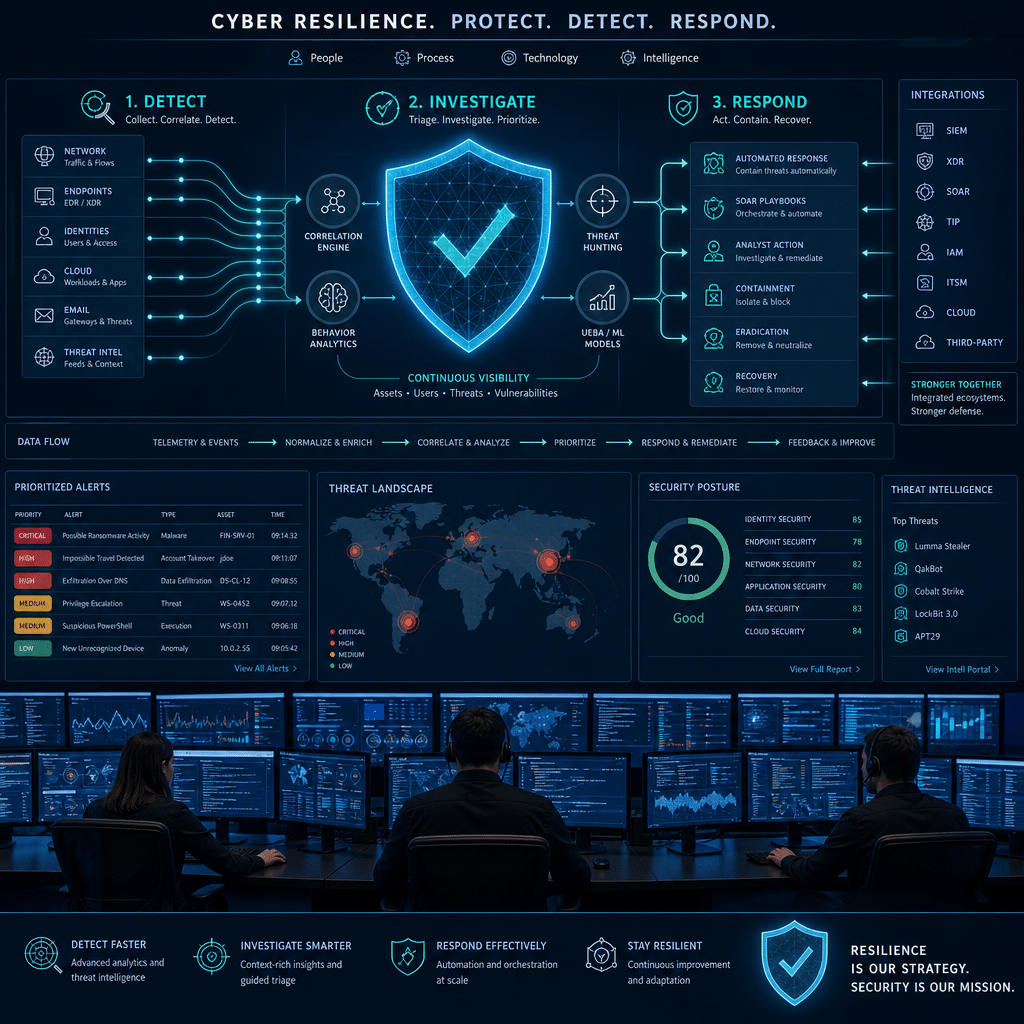
A detection and response stack is meant to help security teams identify threats quickly, investigate them confidently, and contain them before damage spreads. Yet adding more tools does not automatically create better security. Poorly connected platforms, incomplete telemetry, unclear ownership, and noisy alerts can leave an organization with a costly stack that slows response instead of improving it.
Whether you are building a program from the ground up or reviewing an established environment, the most important design decisions are rarely about buying the newest product. They are about creating a system that supports clear decisions and consistent action. This guide explains the most common mistakes in detection and response stack design and offers practical ways to avoid them.
Table of Contents
- Starting With Tools Instead of Outcomes
- Ignoring Visibility and Data Quality
- Creating Alert Noise Without Prioritization
- Building Disconnected Investigation Workflows
- Overlooking Response and Recovery
- Neglecting People, Skills, and Ownership
- Failing to Measure and Improve the Stack
- A Practical Roadmap for Better Stack Design
- Conclusion
Starting With Tools Instead of Outcomes
One of the most common mistakes is selecting security tools before defining what the organization needs to detect and how it will respond. A product-centered approach often produces overlapping capabilities, unused features, and gaps that are not discovered until an incident occurs.
Begin with security outcomes. Ask which business assets matter most, which threats are most relevant, and how quickly the team must detect and contain them. For example, an organization may prioritize protecting privileged accounts, customer data, cloud workloads, or operational technology. Those priorities should shape the data sources, detections, integrations, and response procedures in the stack.
Define success before selecting technology
- Identify critical assets, users, applications, and business processes.
- Document likely threat scenarios and the actions they would require.
- Set practical objectives for detection time, investigation time, and containment time.
- Map each proposed tool to a specific capability or measurable outcome.
This approach also makes procurement more disciplined. If two platforms perform the same function, the better choice is usually the one that integrates more easily, produces higher-quality data, or reduces operational effort.
Ignoring Visibility and Data Quality
Detection is only as effective as the telemetry behind it. Teams often focus on collecting large volumes of logs while overlooking whether the data is complete, timely, normalized, and usable. More data can create more storage costs and alert volume without improving visibility.
Start by creating a data inventory. Record where each source comes from, what events it provides, how frequently it is updated, how long it is retained, and who owns it. Include identity systems, endpoints, networks, cloud services, applications, databases, email, and security controls where they are relevant to your threat model.
Common visibility gaps
- Cloud activity is monitored, but identity and privilege changes are not.
- Endpoint logs are collected without process, command-line, or user context.
- Critical applications produce logs, but the logs are not retained long enough for investigations.
- Time stamps use inconsistent time zones, making event correlation unreliable.
- Assets are not mapped to owners, business functions, or risk levels.
Data quality should be tested continuously. Confirm that expected events are arriving, fields are populated consistently, and collection failures generate visible warnings. Establishing a minimum telemetry standard for each important asset class helps prevent a false sense of coverage.
Creating Alert Noise Without Prioritization
Alert fatigue is a design failure, not simply an analyst performance problem. When a stack generates too many low-value alerts, analysts begin spending less time on meaningful investigations. Important signals may be missed among repetitive notifications and weakly correlated events.
Effective detection engineering starts with a clear purpose for every rule. A detection should identify a meaningful behavior, provide enough context to investigate it, and lead to a defined next step. Rules that produce no actionable response should be revised, suppressed, or removed.
Improve signal quality
- Rank detections according to asset criticality, confidence, and likely business impact.
- Use enrichment such as identity, asset ownership, vulnerability status, and threat intelligence.
- Group related events into cases instead of sending separate alerts for every activity.
- Apply tuning based on documented exceptions rather than broad, permanent exclusions.
- Review false positives and missed detections after investigations and incidents.
Prioritization should be transparent. Analysts need to understand why an alert has a certain severity and what evidence supports that rating. A simple, explainable scoring model is often more useful than a complex score that cannot be challenged or improved.
Building Disconnected Investigation Workflows
A detection and response stack can contain excellent individual products and still fail as a system. Analysts may need to move between a security information and event management platform, endpoint console, cloud portal, ticketing system, identity provider, and collaboration tools. Every manual handoff adds delay and increases the chance of missing context.
Design the investigation workflow around the analyst’s decisions. A case should bring together the alert, related events, affected assets, user details, evidence, notes, and response history. Integrations should make common actions easy without removing appropriate approval and oversight.
Prioritize useful integrations
- Synchronize asset and identity context across security platforms.
- Link alerts to cases, tickets, investigation notes, and evidence.
- Automate repetitive enrichment, such as reputation checks and ownership lookups.
- Connect approved containment actions to endpoint, identity, network, and cloud controls.
- Record every automated and manual action for auditability.
Automation should be introduced carefully. Begin with low-risk tasks, such as enrichment, tagging, and notification. Use human approval for actions that could disrupt operations, such as disabling an account, isolating a production server, or blocking a business-critical service.
Overlooking Response and Recovery
Many organizations invest heavily in detection and treat response as an afterthought. A warning has limited value if the team cannot determine who should act, what action is permitted, or how to restore normal operations safely.
For priority scenarios, create response playbooks that explain the decision process rather than merely listing technical commands. A useful playbook identifies the trigger, required evidence, decision points, approvals, communication requirements, containment options, recovery steps, and documentation expectations.
Make playbooks operational
- Assign an owner and backup owner for each playbook.
- Define conditions for escalation to management, legal, privacy, or external responders.
- Include alternate procedures for unavailable tools or compromised accounts.
- Test playbooks through tabletop exercises and controlled technical simulations.
- Update procedures after incidents, exercises, and major technology changes.
Recovery also belongs in stack design. Detection teams need visibility into backups, system dependencies, identity restoration, and business continuity plans. Otherwise, containment may stop the threat but leave the organization unable to resume reliable operations.
Neglecting People, Skills, and Ownership
Technology cannot compensate for unclear accountability. A stack may span security operations, infrastructure, cloud, application development, identity, risk, and business teams. If ownership is not defined, alerts can remain unresolved while each group assumes another team is responsible.
Create a responsibility model for the full lifecycle of a detection. Define who maintains the rule, validates the data source, investigates the alert, approves containment, communicates impact, and closes the case. Include service-level expectations that reflect alert severity and business risk.
Skills matter as well. Analysts need training on the technology, but they also need practice with investigation methods, cloud environments, identity abuse, scripting, evidence handling, and clear communication. A smaller stack operated confidently is usually stronger than a larger stack that few people understand.
Support sustainable operations
- Document procedures in a central, accessible knowledge base.
- Use shift handoffs and case notes to preserve investigation context.
- Schedule time for detection maintenance, not only incident response.
- Track workload and burnout indicators alongside technical metrics.
- Use managed services or specialist partners where internal coverage is limited.
Failing to Measure and Improve the Stack
A stack should evolve as the organization, threat environment, and technology landscape change. Without measurement, teams may mistake activity for effectiveness. The number of alerts closed does not show whether the right threats were detected or whether response improved.
Use a balanced set of operational and outcome-focused metrics. Useful measures may include mean time to detect, mean time to contain, investigation duration, false-positive rate, telemetry availability, playbook usage, and the percentage of critical assets covered by meaningful detections.
Use metrics as learning tools
Metrics should help answer practical questions. Are high-risk assets receiving appropriate coverage? Are analysts spending time on the most important cases? Are automated actions reducing response time without creating unacceptable risk? Are detection gaps being identified through exercises and threat-led reviews?
Review these measures regularly with both technical and business stakeholders. Avoid using metrics to punish individuals for complex incidents. Instead, use them to identify process friction, missing data, unrealistic expectations, and investments that would improve resilience.
A Practical Roadmap for Better Stack Design
Improving a detection and response stack does not require replacing everything at once. A phased roadmap reduces disruption and creates evidence for each investment.
- Assess the current state. Inventory tools, data sources, detections, integrations, playbooks, owners, and known gaps.
- Prioritize business risk. Focus first on critical assets, high-impact scenarios, and areas where response delays would be costly.
- Fix foundational visibility. Improve asset context, identity data, time synchronization, log quality, retention, and collection monitoring.
- Reduce noise. Tune, consolidate, and prioritize detections before adding large numbers of new rules.
- Connect workflows. Integrate case management, enrichment, investigation tools, and carefully selected response actions.
- Test and learn. Run exercises, measure results, collect analyst feedback, and update the roadmap.
At every stage, document the trade-offs. Security leaders can then explain not only what the stack does, but also which risks remain, why they remain, and what investment would address them next.
Conclusion
A strong detection and response stack is not defined by the number of products it contains. It is defined by the quality of its visibility, the relevance of its detections, the speed and safety of its workflows, and the people responsible for operating it.
Avoid starting with tools, collecting data without a purpose, tolerating excessive alert noise, and treating response as an afterthought. Build around business outcomes, connect the investigation lifecycle, test your assumptions, and improve the stack using evidence. The result will be a more focused and resilient security operation that can make better decisions when they matter most.
Frequently Asked Questions
What is a detection and response stack?
It is the combination of data sources, security tools, detection rules, investigation workflows, response capabilities, and people used to identify and manage security threats.
Should an organization prioritize more tools or better integrations?
Better integrations are often the higher-value priority. Connected tools that share context and support consistent workflows can be more effective than a larger collection of isolated products.
How can teams reduce alert fatigue?
Define the purpose of each detection, improve enrichment, group related events, prioritize alerts by risk and confidence, and regularly remove or tune rules that do not lead to useful action.
How often should a detection and response stack be reviewed?
Perform continuous monitoring of data quality and alerts, conduct formal reviews at least quarterly, and reassess the stack after major incidents, technology changes, or significant shifts in business risk.
Leave a Reply