
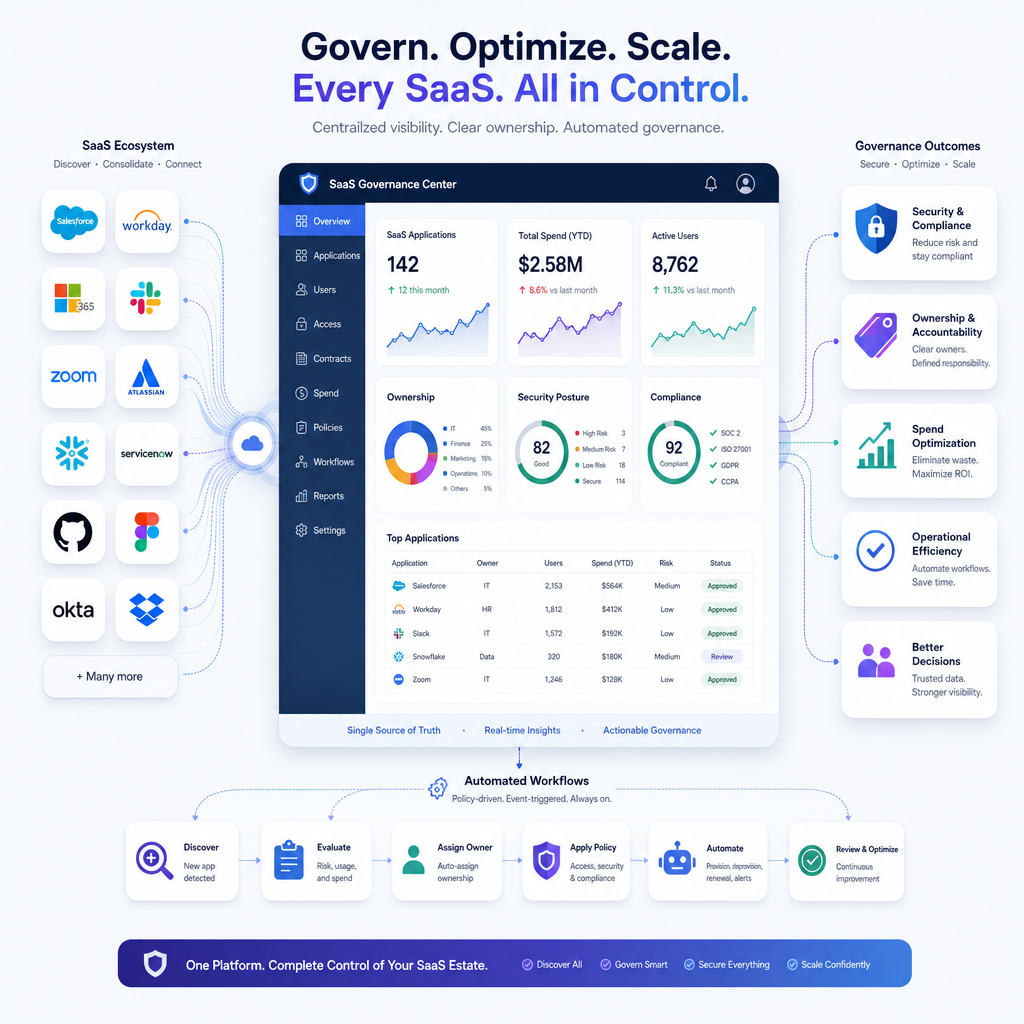
Most organizations do not adopt too many SaaS tools in a single decision. Sprawl develops gradually: one team buys a project platform, another adds a collaboration app, and an individual employee starts a free trial to solve an urgent problem. Over time, the business pays for overlapping software, manages unnecessary security exposure, and loses visibility into how work gets done.
The answer is not to eliminate every tool or force every team onto a single platform. Effective SaaS sprawl management creates a practical operating system for software: measure usage, define ownership, establish clear policies, and automate repetitive controls. This playbook explains how organizations can reduce waste while preserving the flexibility and productivity that SaaS provides.
Table of Contents
- What Is SaaS Sprawl?
- Measure the Problem Before Solving It
- Build a Practical SaaS Governance Policy
- Create and Maintain an Application Inventory
- Use Automation to Control SaaS Sprawl
- Reduce Cost and Operational Risk
- A SaaS Sprawl Implementation Roadmap
- Conclusion
- Frequently Asked Questions
What Is SaaS Sprawl?
SaaS sprawl is the uncontrolled growth of cloud applications across an organization. It includes officially approved platforms, department-specific subscriptions, employee-purchased tools, duplicate applications, dormant accounts, and unsanctioned software that IT or security teams may not know about.
Sprawl creates several connected problems. Finance may pay for unused licenses, IT may struggle to provision and deprovision accounts, and security teams may be unable to assess the data stored in every application. Employees can also waste time switching between tools or searching for information across disconnected systems.
However, the goal is not simply to reduce the number of applications. A smaller software portfolio is valuable only when it improves cost efficiency, security, user experience, and operational clarity. The right question is: Which applications create measurable value, and are they governed appropriately?
Measure the Problem Before Solving It
Reliable metrics turn SaaS sprawl from a vague concern into a manageable business issue. Start by establishing a baseline across applications, users, costs, ownership, usage, and risk. Avoid collecting data that no team will use; focus on metrics that support a decision.
Core SaaS sprawl metrics
- Total application count: Track approved, unapproved, trial, and discovered applications.
- Annual and monthly spend: Include subscription fees, implementation costs, integrations, and administration time when possible.
- License utilization: Compare purchased seats with assigned seats and active users.
- Inactive account rate: Identify accounts with no meaningful activity during a defined period.
- Application overlap: Find tools that provide similar capabilities, such as multiple messaging, storage, design, or project management platforms.
- Time to offboard: Measure how quickly access is removed after an employee leaves or changes roles.
- Risk coverage: Track the percentage of applications with an owner, security review, data classification, and renewal date.
- Shadow IT discovery rate: Monitor how many applications are found outside the approved intake process.
These metrics should be segmented by department, location, business unit, and application category. A high license utilization rate may look positive overall but hide poor adoption in one department. Similarly, a small application may create significant risk if it stores sensitive customer or employee data.
Define useful thresholds
Metrics become actionable when connected to thresholds. For example, an application with fewer than 20 percent active users could trigger a license review, while an application without a documented owner could be placed on a governance exception list. Thresholds should guide investigation rather than automatically force cancellation.
Set a small number of initial targets, such as reducing unused licenses by 15 percent, assigning owners to 100 percent of business-critical applications, or reviewing all high-risk tools before renewal. These goals create momentum without making the program difficult to manage.
Build a Practical SaaS Governance Policy
A SaaS policy should make the safe, approved path easier than the unstructured alternative. Long documents filled with technical language rarely change behavior. Instead, define a simple process for requesting, approving, purchasing, using, and retiring software.
Key elements of the policy
- Application request: Employees or teams submit the business need, expected users, data involved, integrations required, and estimated cost.
- Risk and compliance review: Security, privacy, legal, or compliance teams review applications according to their data and business impact.
- Ownership assignment: A named business owner accepts responsibility for value, usage, renewals, and policy compliance.
- Procurement control: Purchases follow approved contract, budget, and vendor management processes.
- Access management: Users receive the minimum appropriate access through centralized identity controls where available.
- Renewal review: Teams confirm usage, performance, cost, and continued business need before renewal.
- Retirement process: The organization exports or preserves necessary data, removes access, cancels billing, and documents the decision.
Make the policy proportional to risk. A lightweight productivity tool may need a quick review, while an application processing payment data or sensitive personal information may require a deeper assessment. A tiered approach prevents governance from becoming a bottleneck.
Clarify responsibilities
Governance fails when everyone assumes someone else is accountable. Define responsibilities across IT, security, finance, procurement, legal, department leaders, and application owners. A simple responsibility matrix can specify who approves, who provides input, who operates the application, and who makes the final renewal decision.
Employees also need clear guidance. Explain which tools are approved, how to request a new application, why personal accounts may create risk, and what happens to business data stored in unapproved services. Communication should emphasize enablement and protection rather than punishment.
Create and Maintain an Application Inventory
An application inventory is the operational foundation of SaaS control. It should be more than a static spreadsheet. Treat it as a living record that combines procurement data, identity data, expense information, security findings, and usage signals.
Recommended inventory fields
- Application name, category, vendor, and product URL
- Business owner and technical owner
- Departments and users served
- Contract value, billing schedule, and renewal date
- Number of purchased, assigned, and active licenses
- Data types stored or processed
- Authentication and integration details
- Security, privacy, and compliance review status
- Business criticality and recovery requirements
- Renewal decision, retirement date, or exception status
Use multiple discovery methods because no single source shows the complete picture. Review corporate card and expense records, procurement systems, single sign-on logs, browser or endpoint telemetry, finance ledgers, and employee surveys. Compare these sources to identify applications that are paid for but not centrally managed.
Inventory quality should also be measured. Track the percentage of applications with complete ownership, current usage data, verified renewal dates, and an up-to-date risk rating. If records become outdated, the inventory will lose credibility and teams will return to informal purchasing.
Use Automation to Control SaaS Sprawl
Manual reviews are useful at the beginning, but they do not scale. Automation can connect discovery, approval, access management, license optimization, and renewal workflows. The objective is not to automate every decision; it is to remove repetitive work and surface the decisions that require human judgment.
High-value automation opportunities
- Automated discovery: Continuously detect new applications through identity providers, expense systems, corporate card feeds, and network or endpoint signals.
- Approval routing: Send requests to the right stakeholders based on cost, data type, department, and business criticality.
- Identity lifecycle management: Automatically provision and remove access when employees join, leave, or change roles.
- License reclamation: Flag inactive users and notify managers before reclaiming or reallocating seats.
- Renewal alerts: Trigger reviews well before contract deadlines, allowing time for negotiation or migration.
- Risk monitoring: Alert owners when vendor certifications expire, integrations change, or security requirements are not met.
- Workflow documentation: Record approvals, exceptions, decisions, and evidence in a central system.
Automation should include safeguards. Do not immediately disable an account solely because activity appears low; some users may access a system seasonally or perform administrative tasks that are not reflected in standard usage data. Use notification, manager confirmation, grace periods, and escalation before irreversible action.
Connect the right systems
The most effective control environment usually connects an identity provider, human resources system, procurement or financial platform, contract repository, ticketing system, and security tools. Integration allows a role change in the HR system to trigger access updates, a renewal date to create a review task, and an unapproved purchase to enter the intake workflow.
Start with a few high-volume workflows rather than attempting a large technology rollout. Automating joiner, mover, and leaver processes or reclaiming inactive licenses often produces visible results quickly.
Reduce Cost and Operational Risk
Cost reduction is often the first reason leaders support SaaS governance, but savings should not be the only measure of success. A tool that appears expensive may support a critical workflow, while a low-cost application may create significant security or compliance exposure.
Practical cost controls
- Consolidate overlapping tools when one platform can meet the core need.
- Reclaim inactive or duplicate licenses before purchasing additional seats.
- Align subscription tiers with actual feature usage.
- Negotiate based on active users, growth forecasts, and multi-year value rather than maximum theoretical demand.
- Coordinate renewals so the organization can evaluate related applications together.
- Include administration, integration, migration, and exit costs in the total cost of ownership.
Risk reduction requires similar discipline. Prioritize applications that handle sensitive data, connect to core systems, or lack strong authentication and audit controls. Require appropriate safeguards such as single sign-on, multi-factor authentication, role-based access, data retention rules, vendor agreements, and export capabilities.
Track business outcomes alongside savings. Useful measures include fewer orphaned accounts, faster offboarding, reduced audit findings, fewer duplicate tools, improved support response times, and higher employee satisfaction with the approved software portfolio.
A SaaS Sprawl Implementation Roadmap
Organizations can begin with a focused 90-day program and expand over time. The following sequence balances visibility, quick wins, and long-term governance.
- Days 1–30: Discover and baseline. Gather application and spending data from major systems. Identify the highest-cost tools, critical applications, unmanaged accounts, upcoming renewals, and obvious duplicates. Assign an executive sponsor and establish initial metrics.
- Days 31–60: Prioritize and define policy. Group applications by risk and business value. Select a few categories for consolidation, define the intake and renewal process, assign owners, and communicate the policy to department leaders.
- Days 61–90: Act and automate. Reclaim unused licenses, address high-risk applications, review near-term renewals, and automate one or two workflows. Document results and use the lessons to improve the operating model.
After the initial program, establish a regular operating rhythm. A monthly review can focus on new applications, access changes, and urgent risks. A quarterly review can examine utilization, spending, exceptions, and duplicate capabilities. An annual portfolio review can evaluate strategic consolidation, vendor performance, and policy effectiveness.
Keep an exception process for legitimate business needs. Every exception should have an owner, reason, risk assessment, compensating controls, and expiration or review date. This preserves flexibility while preventing temporary exceptions from becoming permanent blind spots.
Conclusion
SaaS sprawl is not solved by one audit or one software platform. It is controlled through a repeatable operating model that combines reliable metrics, proportional policies, clear ownership, a current application inventory, and targeted automation.
Start by making the invisible visible. Then focus on the applications, licenses, and workflows that create the greatest cost or risk. With consistent reviews and smart automation, organizations can build a leaner SaaS portfolio without slowing teams down or limiting useful innovation.
Frequently Asked Questions
What is the fastest way to identify SaaS sprawl?
Compare data from expense systems, procurement records, identity provider logs, corporate card statements, and endpoint or network discovery tools. The differences between these sources often reveal unmanaged applications and duplicate subscriptions.
Who should own SaaS governance?
SaaS governance is typically shared across IT, security, finance, procurement, legal, and business departments. One program owner should coordinate the process, while each application should have a named business owner accountable for value, usage, and renewal decisions.
How often should SaaS licenses be reviewed?
Review high-cost and high-risk applications at least quarterly, especially before renewal. Lower-risk tools can follow an annual review cycle, supported by automated alerts for inactivity, ownership gaps, and access changes.
Does controlling SaaS sprawl mean reducing every application?
No. The goal is to remove unnecessary duplication and risk while preserving tools that deliver value. A well-governed portfolio may contain many applications, provided they have clear owners, appropriate controls, measurable use, and a justified business purpose.
Leave a Reply